Introduction: Why the Impeller Is the Heart of Your Pump:
If you’ve ever deal with a centrifugal pump that wasn’t moving water or gas efficiently, running too hot, or losing pressure – chances are the impeller was the problem.
The centrifugal pumps impeller is the single most important component inside the pump. It does all the real work: spinning at high speed, grabbing the fluid, and pushing it outward with centrifugal force. Without a properly designed and correctly chosen impeller, even the most expensive pump body is useless.
Whether you’re an engineer specifying pumps for an industrial plant, a facilities manager replacing a worn part, or just someone trying to understand why your pump isn’t performing – this guide breaks it all down in plain language.
Let’s start from scratch.
👉 Learn practical maintenance techniques of rotating equipment here: [If you want to deeply understand compressors, pumps, and other rotating equipment with real-world industrial examples, this course is highly recommended.
👉 Learn practical Rotating equipment masterclass here: [trk.udemy.com/enqb2r]
What Is a Centrifugal Pump Impeller?
A centrifugal pump impeller is a rotating disc with curved vanes (blades) attached to it. When the impeller spins – driven by a motor through a shaft – it pulls fluid in through the center (called the eye) and flings it outward toward the pump casing using centrifugal force.
Think of it like a spinning lawn sprinkler. Water comes in from the center and gets thrown outward by rotation. The faster it spins, the more force and flow it generates.
The impeller converts mechanical energy (rotation from the motor) into kinetic energy (fluid movement). The pump casing then converts that kinetic energy into pressure, which pushes the fluid through your pipes.
Simple concept. Huge impact.
How a Centrifugal Pump Impeller Works: Step by Step:
Here’s the process broken down clearly:
Step 1 – Fluid enters the eye: The suction side of the pump draws fluid into the center of the impeller, called the “eye.” This happens because the rotating impeller creates a low-pressure zone at its center.
Step 2 – The vanes grab the fluid: As the impeller rotates, its curved vanes catch the incoming fluid and accelerate it. The shape of the vanes determines how smoothly and efficiently this transfer happens.
Step 3 – Centrifugal force throws fluid outward: Spinning at 100 or 1000 of RPM, the impeller flings fluid toward the outer edge at high velocity. At this point, the fluid has gained significant kinetic energy.
Step 4 – The casing converts velocity to pressure: The volute casing (the snail-shaped housing around the impeller) slows the fluid down in a controlled way, converting its speed into static pressure. That pressure drives the fluid through your discharge pipe.
The efficiency of every single step depends heavily on impeller design. Get the impeller wrong, and you waste energy, reduce flow, or damage the pump.
📘 Suggested Course: Centrifugal Pumps – Principles, Operation and Design
👉 If you want to clearly understand pump working principles, hydraulic design, and real-world industrial applications, this course is highly recommended.
👉 Learn pump fundamentals and design concepts here: [https://trk.udemy.com/PzK1XN]
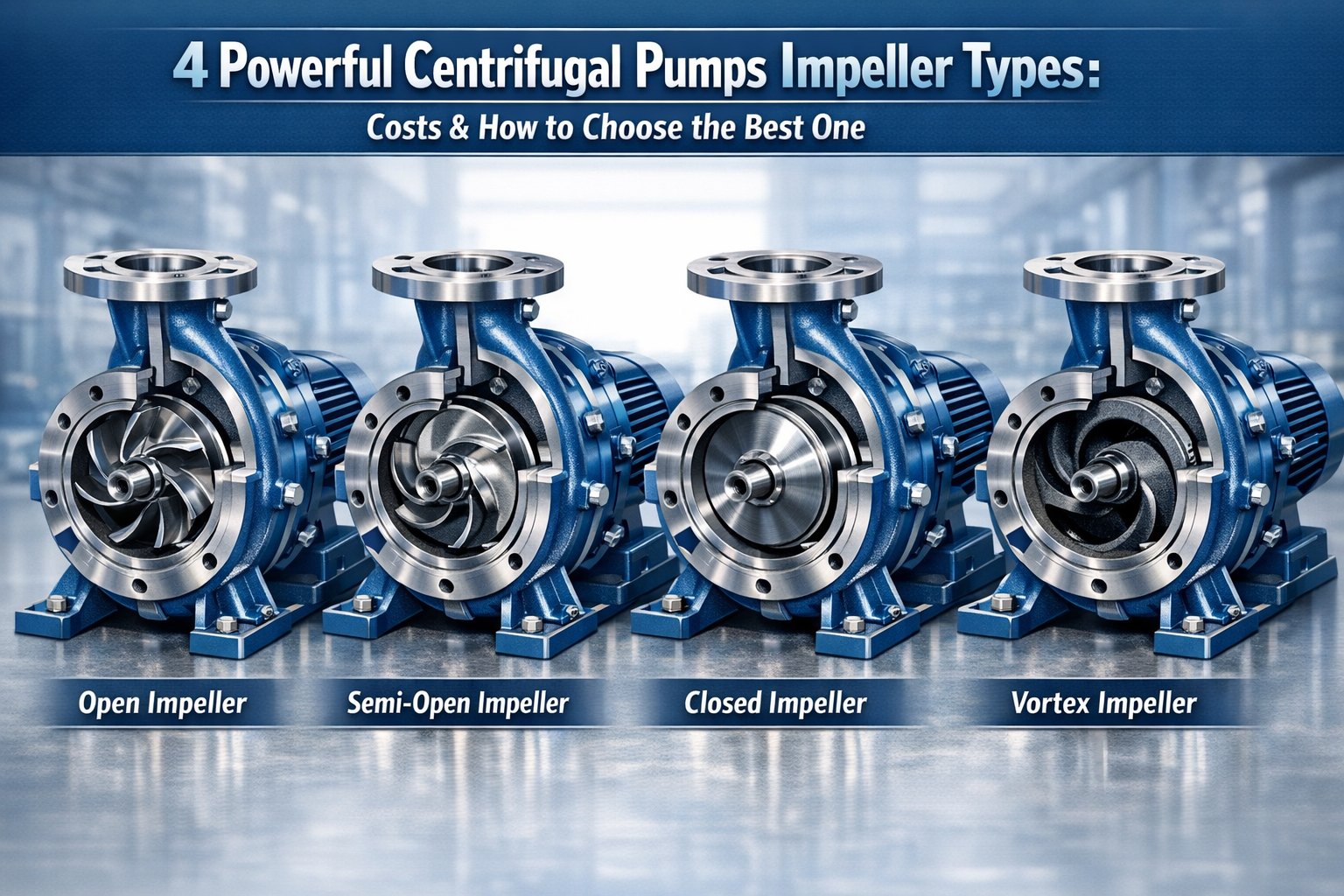
Key Types of Centrifugal Pump Impellers:
This is where selection matters most. There are three main types, each designed for different applications.
1. Closed Impeller:
- A closed impeller has front and back shrouds (plates) enclosing the vanes on both sides. The fluid flows through enclosed channels between the vanes.
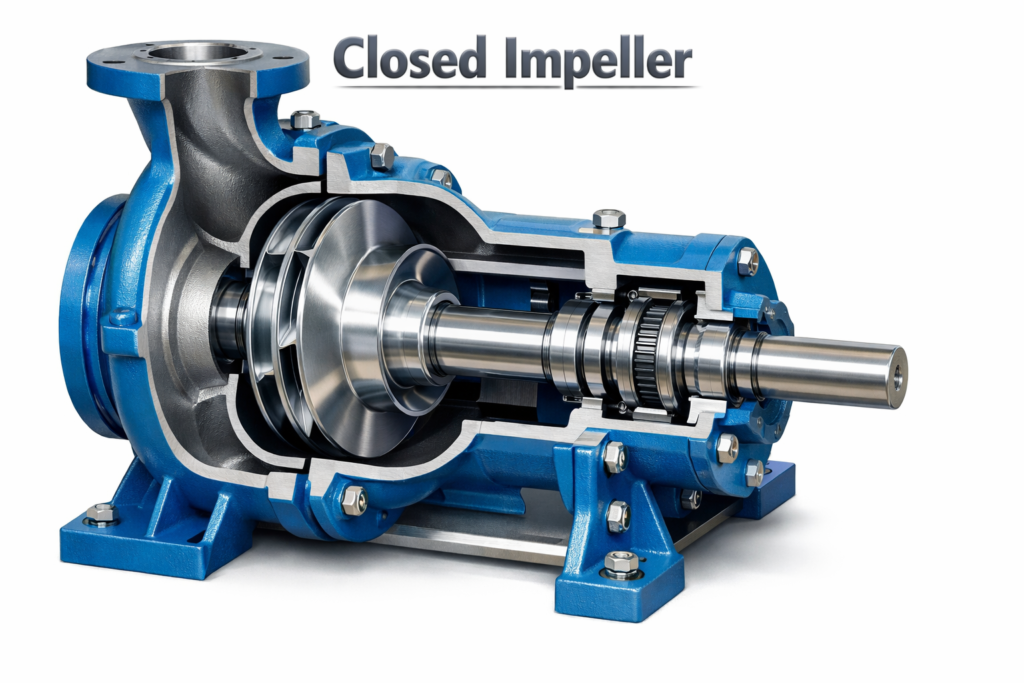
Best for: Clean water, chemicals, light slurries, HVAC systems, boiler feed pumps.
Why choose it: Highest efficiency of all impeller types. The enclosed vanes minimize recirculation and turbulence, meaning less energy wasted. It also generates higher head pressure.
Downside: Not suitable for fluids with suspended solids or fibers – particles get stuck between the tight vane channels.
Typical cost range: $80 to $800+ depending on size and material. Stainless steel or cast iron versions at the lower end; high-alloy or titanium versions for chemical duty at the high end.
2. Open Impeller:
- An open impeller has vanes attached to a central hub with no shrouds covering either side. The vanes are fully exposed.
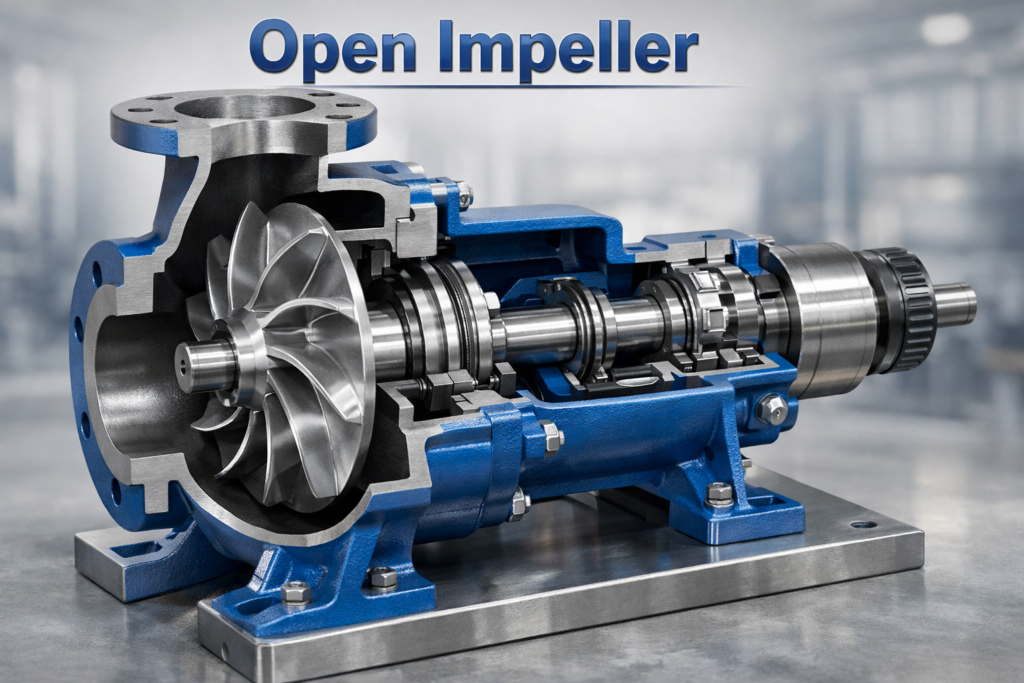
Best for: Slurries, wastewater with solids, paper pulp, sewage, food processing with chunks.
Why choose it: The open design allows solids and fibrous materials to pass through without clogging. It’s also easier to clean and inspect. Many operators prefer open impellers for dirty applications because blockages are much less common.
Downside: Lower efficiency compared to closed impellers. The open design creates more internal leakage (recirculation back toward the suction side), which wastes energy and reduces flow rate.
Typical cost range: $50 to $500. They’re often less expensive to manufacture due to their simpler geometry.
📘 Suggested Course: Pump and Motor Basics, Selection and Optimization (HVAC)
👉 If you want to clearly understand pump selection, motor sizing, and HVAC system optimization with practical examples, this course is highly recommended.
👉 Learn step-by-step fundamentals and real-world applications: [https://trk.udemy.com/PzK1LX]
3. Semi-Open Impeller:
- A semi-open (or semi-closed) impeller is the middle ground. It has one shroud on the back (hub side) but is open on the front facing the casing.
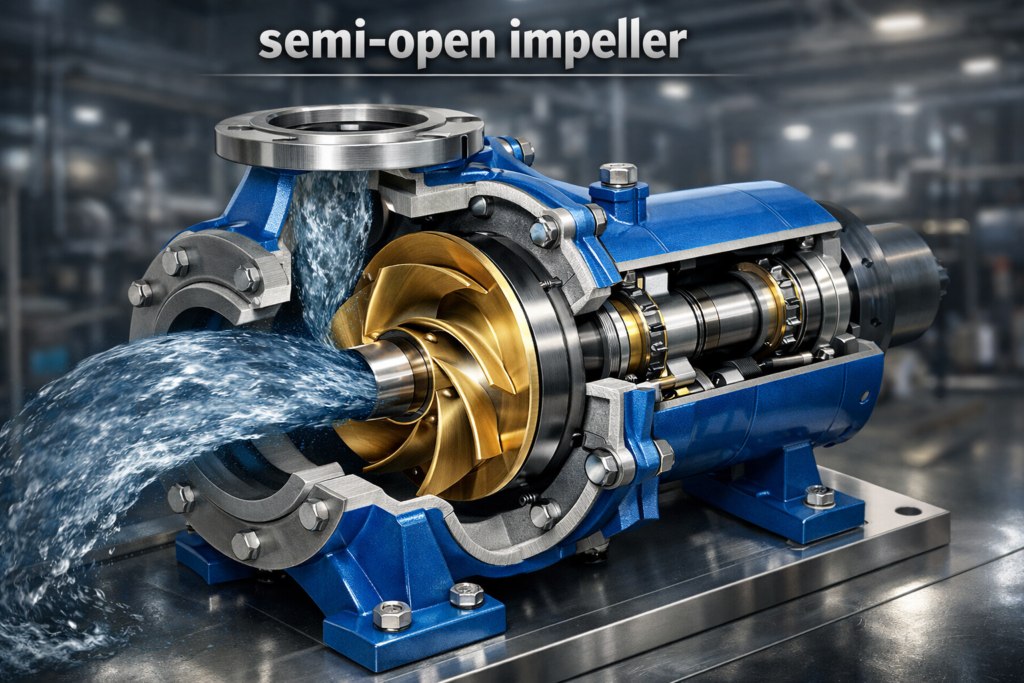
Best for: Moderate solids content, light slurries, paper stock, some chemical applications.
Why choose it: Better efficiency than fully open impellers, but more tolerance for solids than closed ones. A practical compromise when your fluid isn’t clean but isn’t extremely dirty either.
Downside: Requires precise clearance adjustment between the impeller face and the casing. If wear occurs and the gap widens, efficiency drops noticeably.
Typical cost range: $70 to $600. Similar to open impellers but with more machining required.
4. Vortex Impeller:
- A vortex (or recessed) impeller sits back from the flow path and creates a spinning vortex to move fluid without direct contact. It’s specifically designed for sewage pumps and applications with large solids or stringy materials.
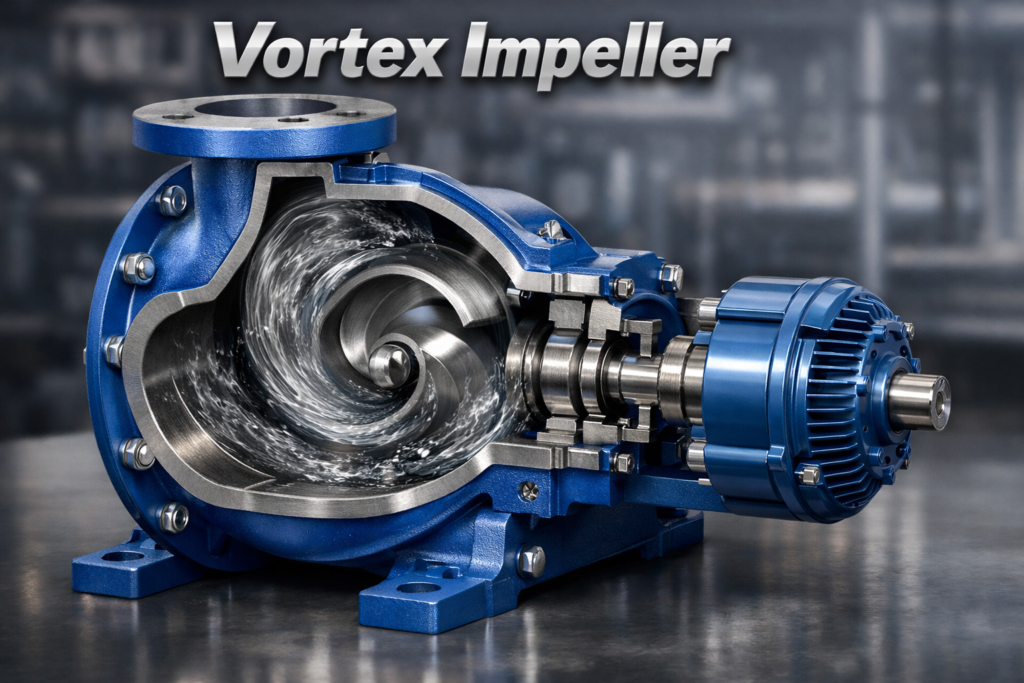
Best for: Raw sewage, trash pumps, solids-heavy industrial discharge.
Cost range: $100 to $1,000+ based on pump size.
📘 Suggested Course: Mastering Pump Fundamentals – Design, Selection & Operation
👉 If you want to clearly understand how pumps are designed, selected, and operated in real industrial applications, this course is highly recommended.
👉 Learn practical pump fundamentals here: [https://trk.udemy.com/4aJ6Qr]
Impeller Materials: What They’re Made Of and Why It Matters:
The impeller material choice is just as important as the type. The wrong material corrodes, erodes, or fails prematurely.
- Cast Iron: Standard choice for clean water and general service. Economical, durable for neutral fluids. Vulnerable to corrosion in acidic or saline environments.
- Stainless Steel (316 or 304): Used in chemical, food, pharmaceutical, and marine applications. Good corrosion resistance. Costs 2–3× more than cast iron.
- Bronze: Common in marine and seawater pumps. Naturally resistant to saltwater corrosion.
- High-Chrome Iron (White Iron): Used in highly abrasive slurry applications like mining or sand pumping. Extremely hard but brittle.
- Thermoplastic (Polypropylene, PVDF): Used in highly corrosive chemical applications where metals would fail. Lightweight and inexpensive but limited to lower temperatures and pressures.
How to Choose the Right Centrifugal Pump Impeller:
This is where a lot of buyers go wrong. They pick based on price or habit rather than application requirements. Here’s a clear decision framework:
- Step 1: Know your fluid: Is it clean, slightly dirty, heavily laden with solids, corrosive, or abrasive? A clean water system and a mining slurry need completely different impellers.
- Step 2: Determine your required flow rate and head: Flow rate (measured in GPM or m³/hr) and total dynamic head (measured in feet or meters) define the performance point. Your impeller’s diameter and vane design must match these numbers. Pump curves – provided by manufacturers – show you how different impellers perform.
- Step 3: Check the solids content: If your fluid contains particles larger than 1/8 inch or fibrous material, eliminate closed impellers immediately. Go semi-open or open.
- Step 4: Match the material to the fluid chemistry: Acidic? Look at stainless steel or plastic. Abrasive? High-chrome iron. Seawater? Bronze or duplex stainless.
- Step 5: Consider energy efficiency: If the pump runs continuously – in HVAC, water treatment, or process plants — closed impellers pay for themselves through energy savings even if they cost more upfront.
- Step 6: Factor in maintenance: Open impellers are easier to inspect and clean. Closed impellers last longer in clean services with minimal maintenance. Know your team’s capabilities and maintenance schedule.
📘 Suggested Course: Pump Sizing & Modeling Piping Systems For Liquids
👉 Proper pump selection and piping design are critical to avoid energy losses, cavitation, and system failures.
👉 Learn how to size pumps and model piping systems effectively: [https://trk.udemy.com/JkJ5E7]
Real-World Experience: The Wrong Impeller Costs More Than You Think:
Here’s a my real work scenario that plays out regularly in industrial facilities.
During working time i worked on my schedule preventive maintenance job, in food processing plant was running a centrifugal pump to move a brine solution with small vegetable pieces through their wash system. The original installer specified a closed impeller – likely because it was the “standard” choice for liquid applications.
Within three months, the pump was losing flow rate. The impeller vane channels were partially blocked by vegetable fibers, and the tight tolerances meant cleaning required full disassembly. Each service call took four hours of downtime and cost around $600 in labor.
A pump specialist recommended switching to a semi-open impeller in 316 stainless steel. The upfront cost was $240 – slightly more than the $180 cast iron closed impeller. But blockages dropped to near zero, maintenance time dropped by 70%, and the pump maintained its flow rate consistently.
Over twelve months, the facility saved an estimated $4,800 in maintenance labor alone.
The lesson: matching the impeller to the actual fluid conditions – not just the “liquid pump” category – is the decision that drives real-world cost and performance.
Common Mistakes When Selecting or Replacing an Impeller:
Mistake 1: Choosing by price alone: The cheapest impeller often has the highest total cost over time. Corrosion, wear, and frequent replacement add up quickly.
Mistake 2: Ignoring clearance settings: Open and semi-open impellers require proper axial clearance between the vane tips and the casing. Too tight and you risk contact damage. Too loose and efficiency drops. Always set clearance per manufacturer specifications after installation.
Mistake 3: Replacing with a different material without checking compatibility: Swapping from cast iron to stainless sounds like an upgrade, but if the pump shaft, casing, and seals aren’t compatible, you may cause galvanic corrosion or seal failure.
Mistake 4: Running a trimmed impeller outside its design range: Impellers can be trimmed (machined smaller in diameter) to reduce flow and pressure. But trimming beyond 10–15% of original diameter often moves the pump operating point far off its best efficiency point, causing vibration, heat buildup, and early failure.
Mistake 5: Ignoring pump curve data: Always match the impeller to the actual system curve – not just theoretical head and flow. Without this step, you’ll constantly fight pump performance issues.
📘 Suggested Course: Flow of Fluids Through Piping Systems, Valves and Pumps
👉 Understanding fluid flow, pressure losses, and valve behavior is essential for designing and maintaining efficient piping systems.
👉 Learn practical fluid flow concepts and real-world applications here: [https://trk.udemy.com/vDyeLy]
Benefits of Choosing the Right Impeller:
Getting the impeller selection right delivers measurable advantages:
- Higher energy efficiency: A properly matched closed impeller can operate at 75–85% efficiency. A mismatched one may fall to 40–50%, wasting significant electricity in continuous-duty applications.
- Longer service life: The right material and design means less wear, less corrosion, and fewer replacements. A quality stainless impeller in a clean-water pump can last 10+ years.
- Reduced downtime: When the impeller handles the fluid correctly, blockages, cavitation, and seal damage drop significantly.
- Better process control: Consistent, predictable flow rates improve quality in manufacturing, chemical processing, and food production.
- Lower total cost of ownership: The purchase price of an impeller is often 5–15% of the total cost it generates over its lifetime through energy consumption and maintenance. Efficiency matters far more than sticker price.
FAQs About Centrifugal Pumps Impeller:
Q1: How do I know if my impeller is worn and needs replacing?
- Common signs of impeller wear include reduced flow rate, loss of discharge pressure, increased vibration and noise, and visible cavitation damage (pitting on vane surfaces). If performance has dropped 15–20% from baseline, inspect the impeller immediately.
Q2: Can I trim my impeller to reduce flow?
- Yes, impeller trimming is a common and accepted method to adjust pump performance to match system requirements. Most manufacturers allow trimming up to 10–15% of the original diameter. Beyond that, you risk pushing the pump too far off its best efficiency point.
Q3: What causes impeller cavitation, and how do I prevent it?
- Cavitation happens when the pressure at the impeller eye drops below the vapor pressure of the fluid, causing tiny bubbles to form and then collapse violently against the vanes. It’s caused by insufficient suction head, excessive flow rates, or fluid running too hot. Prevent it by ensuring adequate net positive suction head (NPSH) and not running the pump beyond its design flow range.
Q4: Is a larger impeller always better?
- Not at all. A larger impeller produces more head and flow – but only up to the pump’s design limits. Oversizing creates excessive motor load, vibration, and can damage shaft seals. Always size the impeller to match your actual system curve.
Q5: What’s the typical lifespan of a centrifugal pump impeller?
- In clean water service with proper maintenance, a quality impeller lasts 7–15 years. In abrasive slurry service, lifespan may be as short as 6–18 months, depending on particle hardness and velocity. Regular inspection every 6–12 months is recommended for any industrial application.
Conclusion: Get the Impeller Right and Everything Else Follows:
The centrifugal pumps impeller isn’t just a rotating part – it’s the core of your entire pump system’s performance. Choose the wrong type, the wrong material, or the wrong size, and you’ll pay for it through wasted energy, frequent maintenance, and premature pump failure.
Here’s the quick summary to take away:
- Use closed impellers for clean fluids where efficiency is the priority.
- Use open or semi-open impellers when solids, fibers, or abrasives are present.
- Match the material to your fluid chemistry and temperature.
- Always reference the pump curve to confirm your operating point.
- Think in terms of total cost of ownership, not just upfront price.
Take the time to specify the right impeller upfront. It’s one of the highest-return decisions you’ll make in any pump application – and one that pays dividends for years.