Introduction: ( What really happens when maintenance fails):
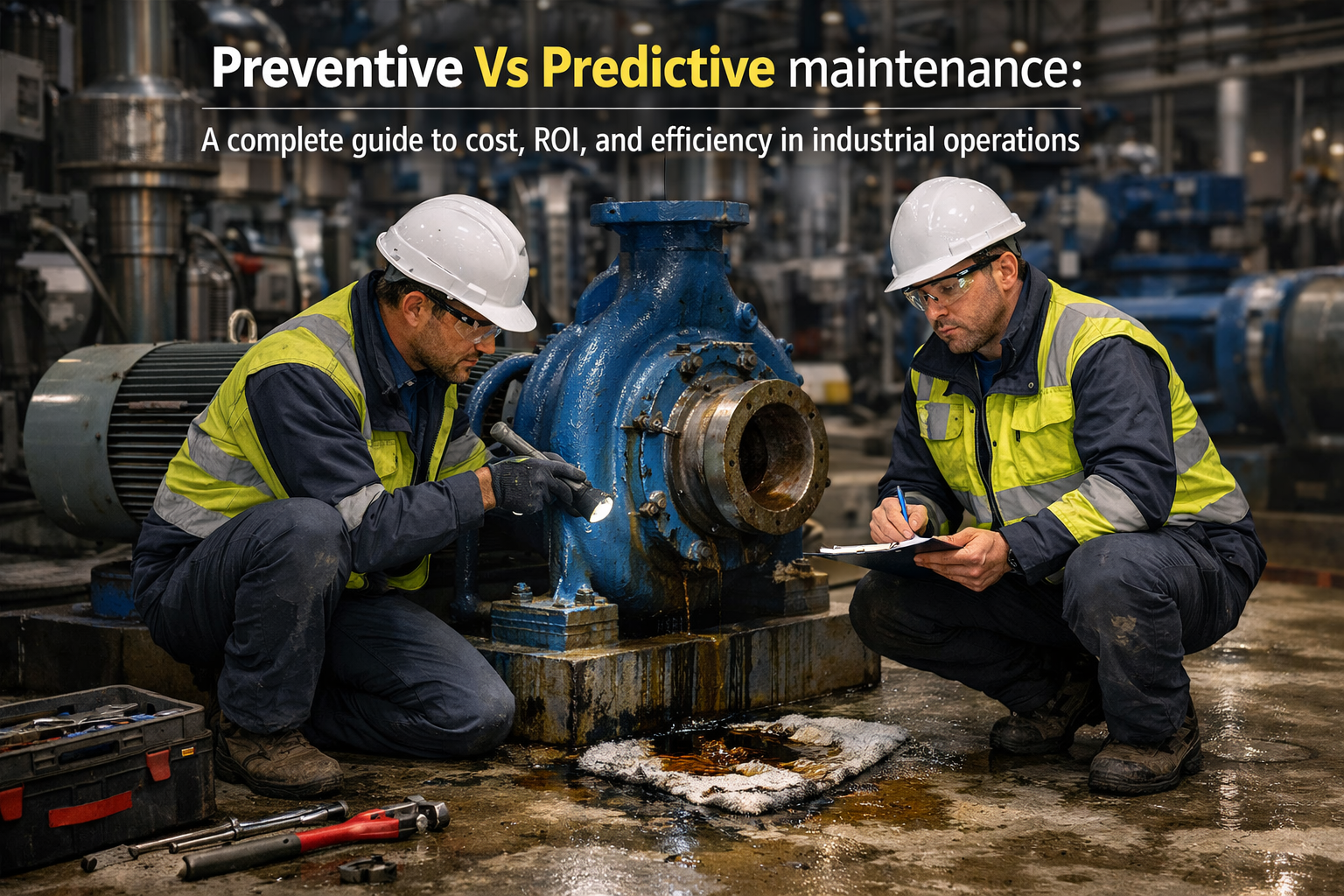
Preventive Vs Predictive maintenance: In most plants i have worked in, machines don’t fail without out of nowhere. They always give you some kind of warning. It might be a small vibration, in a pump, a motor running a little hotter than usual, or a compressor making a sound that just does not feel right. The problem is, when production is going fine, nobody wants to stop and check. Everyone thinks “It’ll run for some more time.”
I have seen this happen again and again. People noting something is off, but since the machine is still running, they leave it. Then one day, it trips. production stops, phones start ringing, and suddenly it becomes a big issue. What could have been a simple bearing change turns into a full shutdown.
In many U.S. plants, even a few hours of a downtime is a big hit. You’re not just fixing a machine, you’re losing production, delaying schedules,and dealing with pressure from every side. That’s why maintenance is not just about tools and repairs. It’s about making the right decision at the right time before things get out of control.
📘 Suggested Course: Maintenance Management & Reliability Crash Course
👉 If you want to reduce unexpected breakdowns, improve equipment reliability, and implement proven maintenance strategies used in real industries, this course is highly recommended.
👉 Learn how to optimize maintenance and boost plant efficiency: [https://trk.udemy.com/X4dQL5]
Understanding preventive maintenance:

What preventive maintenance really means on the shop floor:
Preventive maintenance is basically time-based or usage-based intervention. You’re not waiting for failure – you’re acting before it happens, based on running hours or calendar intervals.
In most plants I have worked in, this is driven through CMMS or asset management systems. For example, a centrifugal pump might be scheduled for bearing replacement every 4000 to 6000 running hours. Motors are greased based on OEM recommendations – say every 2000 hours depending on load and speed. Compressors get opened during planned shutdowns for inspections valves, seals, and clearances.
From a technical side, the idea is simple – you’re trying to keep failure modes under control before they reach a critical stage. For rotating equipment, that usually means targeting – wear related failures like bearing fatigue, lubrication breakdown, or seal degradation.
Where preventive maintenance works well:
Preventive maintenance works best when failure patterns are predictable. For example, if you know a bearing typically fails after a certain number of operating hours under stable load conditions, then replacing it early reduces the risk of unexpected breakdown.
It’s also effective for components where condition monitoring is not easily available or not cost-justified. Things like basic utility pumps, smaller motors, or non-critical equipment – you don’t always need vibration analysis or tomography for everything.
In plants with high production pressure, preventive maintenance also helps in planning shutdowns. Instead of reacting failure, you align maintenance with production schedules, which help control MTTR and avoids emergency work.
📘 Suggested Course: Maintenance Engineering – Predictive Maintenance
👉 If you want to detect failures before they happen and reduce unexpected downtime, this course will help you master real-world predictive maintenance techniques used in industries.
👉 Learn vibration analysis, condition monitoring, and fault detection here: [https://trk.udemy.com/NGznQO]
The hidden problems with preventive maintenance:
Now here’s where things get real from a technical point of view.
Preventive maintenance assumes that failure happens based on time. But in reality, most equipment failures are condition-based, not time-based. Load variation, misalignment, poor lubrication, contamination – all these factors affect failure, and they don’t follow a fixed schedule.
I have seen pumps opened during shutdown just because the schedule said so, and after reassembly, vibration level actually increased. Why? Because perfect alignment was disturbed, or bearing fitting wasn’t done properly. Even a small error in a bearing clearance or coupling alignment can reduce equipment life significantly.
Another issue is premature replacement. Bearings, seals, and other components often have remaining useful life, but they get replaced anyway. This not only increases maintenance cost but also introduces infant mortality failures – where new components fail early due to installation errors or defects.
From a reliability engineering stand point, this directly affects MTBF. Instead of increasing it, excessive preventive maintenance can actually reduce it if not executed properly.
So the problem is not preventive maintenance itself – it’s applying it without considering actual operating conditions and failure behavior.
Understanding predictive maintenance:

What predictive maintenance looks like on the shop floor:
Predictive maintenance is not about guessing – it’s about reading the machine condition and making decisions based on real data. Instead of opening equipment just because the schedule says so, you monitor how it is actually running and intervene only when something starts changing.
On the shop floor, this usually means tracking parameters like vibration, temperature, lubrication condition, and sometimes even current or load variation. For rotating equipment like pumps, motors, and compressors, vibration analysis is one of the most commonly used tools. A small change in vibration spectrum can tell you early if there’s bearing wear, imbalance or misalignment.
Thermography helps identify hot spots in motor, couplings, and electrical panels. Oil analysis gives you internal information without opening the machine – things like contamination, viscosity breakdown, or metal particles from wear. In some plants, ultrasound is used to detect air leaks or early-stage bearing defects.
With industrial IoT sensors and predictive maintenance software, many of these readings are now taken continuously. You don’t have to wait for manual inspection. The system itself alerts you when a parameter crosses a limit. That changes the whole approach – maintenance becomes condition-driven instead of schedule-driven.
📘 Suggested Course: Introduction to Reliability Engineering
👉 If you want to understand failure analysis, reliability concepts, and how to improve equipment life in industrial systems, this course is highly recommended.
👉 Learn reliability engineering fundamentals here: [https://trk.udemy.com/PzK266]
How machines actually fail ( And why this matters):
If you spent enough time around rotating equipment, you will know one thing – failure is a process, not an event. It doesn’t go from healthy to failed in one step.
Taking a bearing failure as an example. First you’ll see a slight increase in vibration amplitude, often in high-frequency ranges. Then the waveform starts changing, and you may notice noise during operation. After that, temperature begins to rise due to increased friction. If it’s still ignored, you will start seeing performance issues – maybe reduced flow in a pump or efficiency drop in a compressor. Finally, it leads to complete failure.
This progression is exactly what predictive maintenance is built around. You’re not waiting for failure – you’re catching the machine somewhere in between early defect and functional failure.
For example, if vibration analysis shows an increase in bearing defect frequencies, you can plan replacement during the next available window. If thermography shows uneven heating in a motor, you can check for overloading or insulation issues before it trips. Oil analysis showing metal particles is a clear sign that internal wear has already started, even if the machine is still running.
From a reliability engineering point of view, this about extending the P-F interval – the time between when a problem starts ( Potential failures) and when it becomes a functional failure.
Why predictive maintenance improves efficiency:
The biggest advantage of predictive maintenance is that it avoids unnecessary intervention. You don’t disturb equipment that is running well, which reduces the risk of introducing new problems like misalignment or installation errors.
At the same time, you don’t wait until failure. Since you already know the condition, you can plan maintenance activities in advance. This improves planning, reduces emergency work, and keeps MTTR under control because everything is prepared before the job starts.
Another important point is maintenance cost reduction. Instead of replacing components early, you use their full life based on actual condition. This directly improves asset utilization and reduces spare consumption.
When predictive maintenance is properly implemented using industrial IoT and integrated asset management systems, the whole maintenance approach changes. You move from reactive firefighting to planned intervention. Overtime, this increases MTBF, reduces downtime cost, and improves overall plant reliability.
In simple terms, you’re no longer guessing – you’re making decisions based on how the machine actually behaving.
Preventive vs predictive maintenance: Key differences:

Time-based vs condition-based thinking:
The real difference between preventive and predictive maintenance comes down to how you make decisions on the shop floor.
With preventive maintenance, the decision is driven by time or running hours. The machine might be running perfectly fine, but once it hits a certain interval, you open it up and service it. It’s a schedule-driven approach, and in many plants, it becomes routine – almost automatic.
Predictive maintenance works the other way around. Here, the machine itself tells you when if need attention. You’re not relying a calendar – you’re looking at actual parameters like vibration levels, temperature trends, lubrication conditions, and performance data. If everything is stable, you leave it alone. The moment you see deviation, that’s when you act.
In practical terms, preventive maintenance says, “We’ve reached 4000 hours – let’s service it.” predictive maintenance says, “Vibration has increased at the bearing frequency – we need to plan intervention.”
📘 Suggested Course: Reliability and Maintenance Engineering – FMEA
👉 If you want to systematically identify failures, reduce downtime, and improve equipment reliability, this course is highly recommended.
👉 Learn Failure Mode and Effects Analysis (FMEA) with practical industrial examples: [https://trk.udemy.com/5kAX7D]
That small shift in thinking makes a big difference in how maintenance is executed.
| Factor | Preventive Maintenance | Predictive Maintenance |
|---|---|---|
| Approach | Time-based or schedule-based | Condition-based using real-time data |
| Decision Making | Based on fixed intervals | Based on equipment condition monitoring |
| Cost Efficiency | Higher due to unnecessary replacements | Lower with maintenance cost reduction |
| Downtime | Planned but sometimes unnecessary | Minimized with early fault detection |
| Technology Used | Basic tools and manual inspection | Industrial IoT, sensors, predictive maintenance software |
| Reliability | Moderate (based on assumption) | High (based on actual equipment condition) |
| Maintenance Strategy | Routine servicing | Condition monitoring and analysis |
Cost and ROI: What plant managers actually care about:
Understanding downtime cost in real operations:
Downtime is one of the biggest expenses in any industrial plant. Depending on industry, even a few hours of shutdown can cost tens of thousands of dollars. In large facilities, the cost can go even higher.
When a critical machine like a compressor or process pump fails unexpectedly, the impact is not just repair cost – it’s lost production, delayed delivery, and sometimes even safety risks.
Cost of preventive maintenance and predictive maintenance:
Preventive maintenance involves regular labor, spare parts, and planned shutdowns. While these costs are predictable, they are not always optimized because of unnecessary works.
Predictive maintenance requires investment in tools like sensors, industrial IoT systems, and predictive maintenance software. It also requires skilled personnel to analyze data. But overtime, it reduces maintenance cost by avoiding unnecessary interventions and preventing major failures.
ROI in simple terms:
Return on investment in maintenance is easy to understand when you look at real scenarios. If your predictive maintenance setup prevents one major failure that could have caused a costly shutdown, the savings often exceed the initial investment.
This is why many plants are moving toward condition monitoring and smarter asset management systems. The goal is not just to maintain equipment, but reduce downtime cost and improve overall efficiency.
📘 Suggested Course: HVAC Maintenance from Zero to Hero (DUAL HVAC Certification)
👉 If you’re starting your journey in HVAC or want to upgrade your maintenance skills from basics to advanced level, this course is a perfect choice.
👉 Learn installation, troubleshooting, and real-world HVAC practices here: [https://trk.udemy.com/0GmkdL]
Real plant examples in experience:
When predictive maintenance could have prevented failure:
- In one plant i worked in, a compressor failed because there was no proper monitoring system in place. The bearing issue developed slowly, but it was never detected. When it finally failed, the plant had to shutdown for several hours, leading to significant losses.
When too much preventive maintenance backfires:
- In another case, a plant followed strict preventive maintenance schedules and opened all pump during every shutdown. Overtime, this led to repeated alignment issues and seal failures. The equipment was being disturbed too often, which actually increase the failure rate.
When predictive maintenance works right:
- I have also seen a plant that implemented predictive maintenance properly using industrial IoT and condition monitoring systems. They tracked equipment health continuously and planned maintenance activities based on real data. Their MTBF improved, MTTR reduced, and most importantly, they avoided unexpected breakdown.
Common mistakes in maintenance strategy:
1). Ignoring early warning signs:
- One of the biggest mistakes is ignoring small changes in machine behavior. Slight vibration or unusual noise is often the first sign of a problem. Experienced technicians pay attention to these details, while others overlook them.
2). Blindly following schedules:
- Not all equipment operates under the same conditions. Following fixed schedules without considering load, environment, and usage can lead to over-maintenance or missed failures.
📘 Suggested Course: Facility Management – Operation, Maintenance & Services
👉 If you want to understand how industrial facilities are managed, maintained, and optimized for efficiency, this course is highly recommended.
👉 Learn practical facility management skills here: [https://trk.udemy.com/yZynky]
3). Misusing data and tools:
- Having advanced tools is not enough. If vibration reports or thermal images are not properly analyzed, they don’t add value. Data must lead to action.
4). Depending only on technology:
- Technology is helpful, but it doesn’t replace experience. Sometimes, a technician’s observation can detect issues that sensors might miss.
Practical advice from the sop floor:
1). Start with critical equipment:
- Focus on machines that have the highest impact on production. These are the ones where predictive maintenance will give the most benefit.
2). Combine both approaches:
- The best strategy is not choosing one over the other. Use preventive maintenance for routine tasks and predictive maintenance for critical components.
3). Understand failure modes:
- Knowing how equipment fails helps you choose the right monitoring method. For example, vibration analysis works well for bearings, while thermography is useful for electrical systems.
4). Invest in training:
- Tools are only as good as the people using them. Make sure your team understands how to interpret data and take the right actions.
📘 Suggested Course: Fundamentals of Reliability Engineering (Accredited)
👉 If you want to truly understand failure analysis, reliability concepts, and how to prevent costly breakdowns in industrial equipment, this course is highly recommended.
👉 Learn reliability engineering from fundamentals to real-world application: [https://trk.udemy.com/GbnAgB]
FAQ:
1). What is the main difference between preventive and predictive maintenance?
- Preventive maintenance follows as fixed schedule, while predictive maintenance uses condition monitoring and predictive maintenance software to act based on real equipment data.
2). Which is more cost-effective: preventive or predictive maintenance?
- Predictive maintenance is more cost-effective because it reduces downtime cost and avoids unnecessary part replacement, improving overall ROI.
3). How does industrial IoT improve predictive maintenance?
- Industrial IoT sensors monitor vibration, temperature and performance in real time, helping predictive maintenance software detect issues early.
4). Can preventive and predictive maintenance be used together?
- Yes most plant used both – preventive for routine tasks and predictive for critical equipment through condition monitoring.
5). What tools are used in predictive maintenance?
- Common tools include vibration analysis, thermography, oil analysis, and systems integrated with asset management systems.
Conclusion: What really matters in the end:
At the end of the day, maintenance is not about fixing equipment – it’s about keeping production running without interruption. Preventive maintenance gives structure, but predictive maintenance brings intelligence into the process.
With the rise of industrial IoT, preventive maintenance software, and advanced asset management systems, it’s now possible to detect problems early and act before they become failures.
The goal is simple. Don’t wait for failure, and don’t fix what isn’t broken. Find the balance between preventive and predictive maintenance, and you’ll see real improvements in cost, efficiency, and reliability.