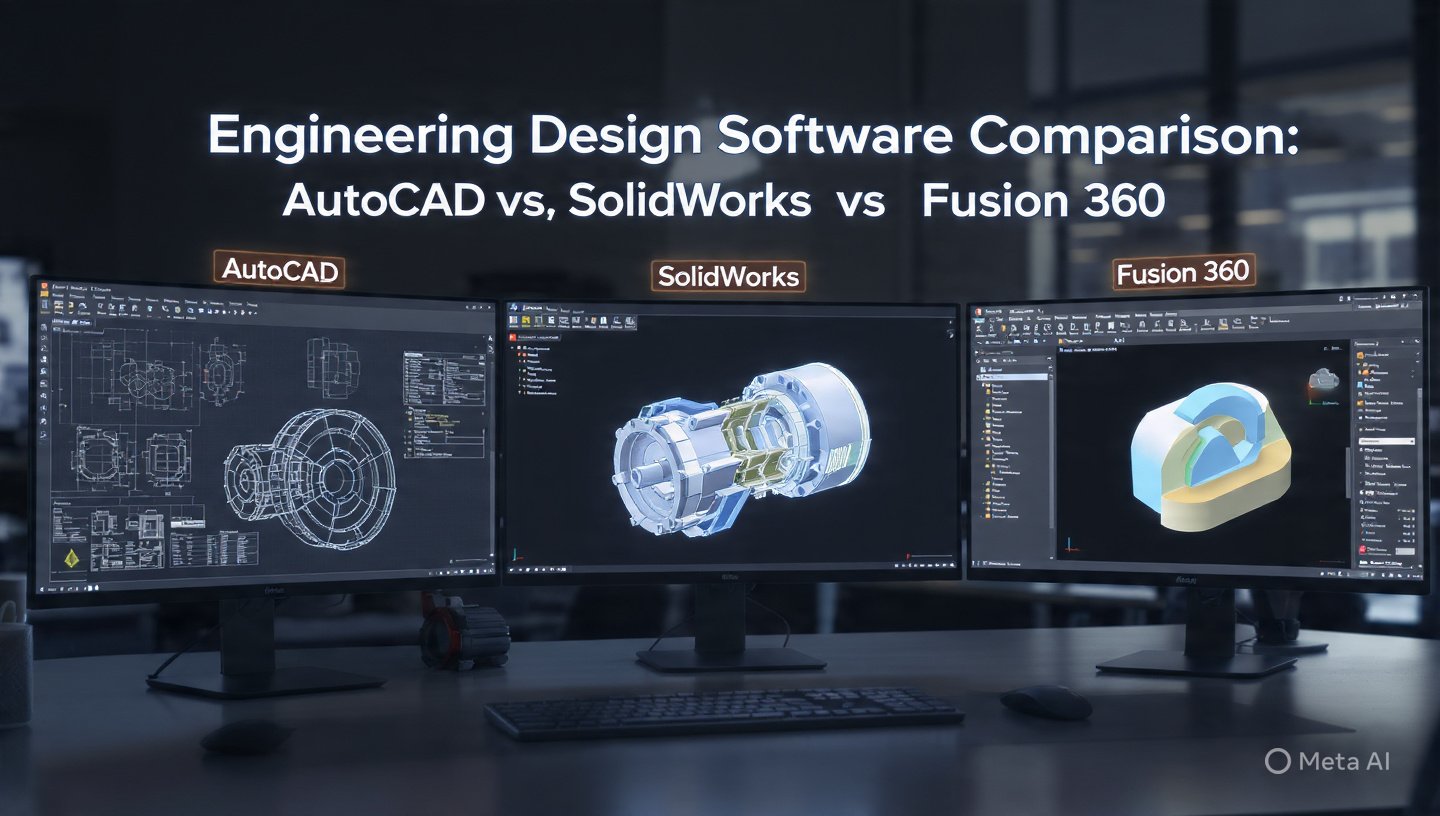
Introduction:
Every few months, someone in an engineering team asks the same question: “Should I be using SolidWorks or Fusion 360? And what’s AutoCAD even good for anymore?”
It’s a fair question. These three tools are all labeled “engineering design software,” they all let you create technical drawings and 3D models, and they’re all made by major companies. But they’re not interchangeable — not even close.
I’ve used all three across different projects: AutoCAD on site layout and civil coordination drawings, SolidWorks for mechanical assemblies in a manufacturing environment, and Fusion 360 for a small product development project where budget was tight and the team wore multiple hats. Each tool has a home. Each one also has frustrations nobody talks about in the official tutorials.
This guide is my honest take on all three, written for engineers and designers who are trying to make a real decision — not just someone looking for a quick ranking chart.
📘 Suggested Course: Autodesk AutoCAD – Beginner to Advanced Level
👉 If you want to master 2D drafting, 3D modeling, and real-world engineering drawings using AutoCAD, this course is highly recommended for beginners to professionals.
👉 Start learning AutoCAD step-by-step here: [https://trk.udemy.com/oNXaZb]
What Is Engineering Design Software?
At its core, engineering design software is any program that helps you create, document, simulate, or communicate a design — whether it’s a simple bracket, a complex machine assembly, or a full building layout.
The three main categories you’ll run into:
- 2D CAD tools — for technical drawings, floor plans, schematics (AutoCAD started here)
- 3D parametric modelers — for solid parts and assemblies (SolidWorks is the classic example)
- Integrated design platforms — tools that combine 3D modeling, simulation, CAM, and collaboration (Fusion 360 is the best-known)
Modern engineering design isn’t just about drawing. It covers the full engineering design process: conceptual layout → detailed design → analysis → documentation → manufacturing handoff. The software you pick should match where you spend most of your time in that process.
Why Choosing the Right Software Matters:
This isn’t just an academic question. The wrong software choice costs you time, money, and sometimes client relationships.
Here’s a real example: A small product design studio I worked with early in my career chose SolidWorks because “everyone uses it.” Three months in, they were drowning in licensing costs and their electrical engineer couldn’t collaborate because there was no good PCB integration. They eventually migrated to Fusion 360 — and lost weeks of rework in the process.
Getting it wrong causes:
- Rework costs — redesigning drawings or models because the output format isn’t compatible with your manufacturer
- Wasted licensing budget — paying $4,000/year for features you’ll never touch
- Slower onboarding — every new hire needs to learn your chosen platform, so switching mid-project is painful
- Integration failures — your design tool should talk to your simulation, PDM, and ERP systems without major workarounds
The engineering design steps you follow — conceptual design, analysis, detailed documentation, review — all need software that fits that workflow. A mismatch between your process and your tool creates friction at every stage.
📘 Suggested Course: AutoCAD Complete Course
👉 If you want to learn AutoCAD from basics to advanced level with real-world engineering drawings, this course is highly recommended.
👉 Start learning AutoCAD step-by-step: [https://trk.udemy.com/R0OD39]
Quick Overview: AutoCAD, SolidWorks, Fusion 360:
- AutoCAD (by Autodesk) has been around since 1982. It’s the standard for 2D drafting and still dominates in civil, architectural, electrical, and plant design. It does 3D, but that’s not where it shines.
- SolidWorks (by Dassault Systèmes) is the go-to for mechanical engineers doing 3D part and assembly modeling in manufacturing. It’s a mature, powerful, desktop-based parametric modeler with a massive user base in industrial product development.
- Fusion 360 (also by Autodesk) is a cloud-connected, all-in-one platform covering 3D CAD, simulation, CAM, and PCB design. It’s aimed at smaller teams, startups, and product designers who need a versatile tool without the complexity of enterprise systems.
Comparison Table: AutoCAD vs SolidWorks vs Fusion 360:
| Feature | AutoCAD | SolidWorks | Fusion 360 |
|---|---|---|---|
| Primary Use | 2D drafting, schematics | 3D mechanical modeling | 3D CAD + CAM + simulation |
| 3D Capabilities | Basic (limited) | Excellent (parametric) | Very good (cloud-based) |
| 2D Drawing | Industry-leading | Good | Adequate |
| Simulation | Minimal | Strong (FEA/CFD add-ons) | Built-in (basic to mid-level) |
| CAM (Machining) | No | Requires add-on (CAMWorks) | Built-in |
| PCB / Electronics | No | No | Yes (basic) |
| Collaboration | File-based | PDM required | Cloud-native |
| Learning Curve | Moderate | Steep | Moderate |
| Platform | Desktop (Windows) | Desktop (Windows) | Cloud + Desktop |
| 2026 Pricing (approx.) | ~$2,145/year | ~$4,195/year | ~$545/year |
| Free Version | LT version (limited) | No | Yes (for personal use) |
| Best For | Civil, AEC, schematics | Manufacturing, industrial | Startups, product design, education |
| Industry Standard In | Civil, electrical, architecture | Automotive, aerospace, machinery | Consumer products, small-batch manufacturing |
📘 Suggested Course: Complete SolidWorks Beginners Course
👉 If you’re starting with 3D design and want to build strong fundamentals in SolidWorks, this beginner-friendly course is highly recommended.
👉 Start learning SolidWorks step-by-step here: [https://trk.udemy.com/enrxGr]
1). AutoCAD: The Industry Standard for 2D Drafting:
Real-World Use Cases:
- AutoCAD is the backbone of 2D documentation in most engineering disciplines — civil, structural, electrical, HVAC, and process piping. In plant and process engineering design, AutoCAD is still the dominant platform for P&IDs, plot plans, and equipment layouts.
- If you’re doing any kind of infrastructure project, site development, or facilities work, your clients and contractors are probably receiving AutoCAD DWG files. That format is the universal language of technical drawing.
- I’ve used AutoCAD extensively on industrial facility layouts. The precision, the ability to work with large drawing sets, and the block library system are genuinely hard to replicate elsewhere. For 2D documentation work, it still does the job better than anything else.
- AutoCAD also has vertical products — AutoCAD Electrical, AutoCAD MEP, AutoCAD Plant 3D — that add discipline-specific tools on top of the core platform. These are worth knowing if you work in those sectors.
Pros:
- Universally accepted DWG format — almost every client can open it
- Extremely precise 2D drafting tools
- Large library of standard blocks and symbol sets
- Solid scripting and automation via LISP and macros
- Vertical versions for specific industries add serious value
- Works well for drawing management on large projects
Cons:
- 3D modeling is clunky compared to dedicated tools
- No built-in simulation or analysis
- Subscription cost is high relative to what casual 2D users actually need
- No real collaboration features (still largely file-based)
- Steep learning curve for AutoCAD Electrical or Plant 3D add-ons
Honest Bottom Line:
- AutoCAD earns its place if your work lives in 2D. For mechanical product designers who mainly do 3D work, it’s probably not the right primary tool — though knowing it is still useful for documentation deliverables.
📘 Suggested Course: SOLIDWORKS – Become a Certified Associate (CSWA)
👉 If you want to build strong 3D modeling skills and get officially certified in SOLIDWORKS, this course is a great starting point.
👉 Start your CSWA journey here: [https://trk.udemy.com/5kMB3L]
2). SolidWorks: The Workhorse of Mechanical Product Design:
Real-World Use Cases:
- SolidWorks is the tool most mechanical engineers are trained on and the one most manufacturing companies expect you to know. If you work in automotive, medical devices, industrial equipment, or consumer hardware, there’s a very good chance your company runs SolidWorks.
- The parametric modeling approach — where every feature is driven by dimensions and relationships — makes design changes manageable even on complex assemblies. When a client changes a wall thickness late in the game, you update one number and watch the whole model rebuild. That’s the core value.
- SolidWorks also has a strong ecosystem. SolidWorks Simulation handles FEA (finite element analysis), SolidWorks Flow Simulation does CFD, and the PDM (Product Data Management) system connects the whole team to a shared vault of controlled files. For companies with 10 to 500 engineers working on a single product, that structure is genuinely valuable.
- I’ve used SolidWorks on complex machinery assemblies — hundreds of parts, multiple configurations, full drawing packages for fabrication. Once you’re proficient, you can move fast. But that proficiency takes time.
Pros:
- Best-in-class parametric 3D modeling for mechanical work
- Huge user community — documentation, tutorials, and peer help everywhere
- Strong simulation tools (FEA, motion, CFD)
- Excellent drawing output for manufacturing
- PDM integration for team file management
- Wide industry acceptance, especially in manufacturing
Cons:
- Expensive — and add-ons (simulation, PDM, rendering) cost extra on top
- Windows-only — no Mac support, no cloud-native option
- Can be slow on large assemblies without a high-spec workstation
- Licensing is seat-based and not flexible for remote or small teams
- Training investment is significant — new users are not productive quickly
Honest Bottom Line:
- SolidWorks is the right tool if you’re doing professional mechanical product design in a team environment. The software pricing is hard to swallow for freelancers or small shops, but if your company is paying the bill, it’s worth every dollar for serious mechanical work.
📘 Suggested Course: Autodesk Fusion 360 (2026) – Complete Beginners Guide
👉 If you’re starting with 3D design and want to learn modeling, simulation, and real-world engineering workflows step by step, this beginner-friendly course is a great place to start.
👉 Learn Fusion 360 from scratch: [https://trk.udemy.com/gRAQVB]
3). Fusion 360: The All-in-One Platform for Modern Product Designers:
Real-World Use Cases:
- Fusion 360 has changed a lot since it launched. It’s no longer just a “cheap SolidWorks alternative” — it’s genuinely good software that covers design, simulation, CAM, PCB layout, and rendering in a single subscription.
- Where it shines is smaller product development projects: consumer electronics, custom hardware, prototyping, small-batch manufacturing runs. If you’re building a product from scratch — designing the parts, running stress analysis, generating toolpaths for your CNC machine, and collaborating with a remote contractor — Fusion 360 lets you do all of that without switching platforms.
- The cloud-native approach is a real advantage for small teams. You can share a design, leave comments, and track versions without setting up a PDM server. For a 3-person startup, that’s the difference between an organized workflow and email chaos.
- I’ve used Fusion 360 on a consumer product development project where the team included a mechanical engineer, an industrial designer, and a contract machinist. The built-in CAM tools saved the machinist the step of re-importing files into a separate CAM program. That alone was worth the subscription cost.
Pros:
- Includes CAD, CAM, simulation, PCB, and rendering in one subscription
- Cloud-based collaboration without extra infrastructure
- Affordable pricing — major advantage for freelancers, students, and small businesses
- Free version available for personal and startup use (with limitations)
- Cross-platform: Windows and Mac
- Regular feature updates
Cons:
- Parametric modeling is less mature than SolidWorks for very complex assemblies
- Cloud dependency can be a problem for teams with data security requirements
- Performance on large assemblies can lag
- Some advanced simulation features are still less capable than SolidWorks Simulation
- Subscription model changes have frustrated some long-term users (feature gating)
Honest Bottom Line:
- Fusion 360 is excellent value for what it costs. It won’t replace SolidWorks in a heavy manufacturing environment, but for product design, prototyping, and small-scale production work, it’s a very capable tool at a fraction of the price.
📘 Suggested Course: Fusion 360 Beginners Course
👉 If you want to start designing 3D models and understand CAD fundamentals step by step, this beginner-friendly course is highly recommended.
👉 Learn Fusion 360 from scratch here: [https://trk.udemy.com/6kPRKr]
Which Software Should You Choose?
Let’s be direct about this:
- You’re a student or recent grad: Start with Fusion 360 (free for students) to learn 3D CAD and CAM basics. Then get SolidWorks training on the side — the Certified SolidWorks Professional (CSWP) credential still carries weight in manufacturing hiring.
- You work in civil, architecture, plant, or electrical engineering: AutoCAD is likely your primary tool. Learn the vertical product for your discipline (AutoCAD Electrical, Plant 3D, MEP) and build your library of blocks and templates.
- You’re a mechanical engineer at a manufacturing company: SolidWorks is the standard. If your company has it, use it. If you’re freelancing and can’t afford the subscription cost, Fusion 360 is a serious alternative for most project types.
- You’re a product designer or hardware startup: Fusion 360 is the right starting point. The combination of CAD, simulation, and CAM in one tool at a manageable price is hard to argue against.
- You’re a small team doing industrial machinery: SolidWorks with PDM is the professional choice. The investment pays off in team productivity and file management over time.
Common Mistakes People Make:
1. Buying SolidWorks before knowing if you need it: Not every mechanical design project needs enterprise parametric modeling. If you’re doing early-stage prototyping, you’re probably paying too much.
2. Using AutoCAD for 3D mechanical work: AutoCAD’s 3D tools exist, but they’re not competitive with SolidWorks or Fusion 360. If your work is 3D-heavy, use a dedicated 3D tool.
3. Ignoring the learning curve in project timelines: New software doesn’t make you productive immediately. Budget training time into any tool switch — realistically, 40 to 80 hours of focused practice before you’re efficient in a new platform.
4. Not checking file compatibility with clients and manufacturers: Ask your manufacturer what formats they accept before you commit to a platform. A SolidWorks file might need to be saved as STEP or IGES for your vendor — which is fine, but know that upfront.
5. Choosing based on online reviews instead of actual use case: Most comparison articles compare features on paper. The feature that matters is whether the software fits your specific engineering design process — not whether it has the longest spec sheet.
📘 Suggested Course: Mechanical Engineering Design – The Ultimate Course
👉 If you want to strengthen your fundamentals in mechanical design, including calculations, material selection, and real-world applications, this course is highly recommended.
👉 Learn complete design concepts here: [https://trk.udemy.com/9VMBDy]
Final Comparison Table:
| Category | AutoCAD | SolidWorks | Fusion 360 |
|---|---|---|---|
| Best For | 2D documentation, civil/electrical | Mechanical product design, manufacturing | Product design, prototyping, startups |
| 3D Modeling | ★★☆☆☆ | ★★★★★ | ★★★★☆ |
| 2D Drafting | ★★★★★ | ★★★★☆ | ★★★☆☆ |
| Simulation | ★☆☆☆☆ | ★★★★★ | ★★★☆☆ |
| CAM | ✗ | Add-on required | ✓ Built-in |
| Collaboration | ★★☆☆☆ | ★★★☆☆ (with PDM) | ★★★★★ |
| Value for Money | ★★★☆☆ | ★★★☆☆ | ★★★★★ |
| Ease of Learning | ★★★☆☆ | ★★☆☆☆ | ★★★★☆ |
| Industry Adoption | Very high (civil/AEC/plant) | Very high (mechanical/mfg) | Growing (product/startup) |
| Annual Cost (2026) | ~$2,145 | ~$4,195 | ~$545 |
| Mac Support | No | No | Yes |
| Free Tier | No (LT trial only) | No | Yes |
Frequently Asked Questions:
Q1: Can I use Fusion 360 instead of SolidWorks professionally?
- Yes, many professional product designers and small engineering firms use Fusion 360 as their primary tool. It handles most mechanical design tasks well. Where it falls short is on very large, complex assemblies and in environments where enterprise-level PDM and formal change management are required.
Q2: Is AutoCAD still relevant in 2026?
- Absolutely. AutoCAD remains the standard for 2D technical documentation in civil, electrical, architectural, and plant/process engineering. It’s not being replaced by 3D tools in those sectors anytime soon.
Q3: Which software is easiest to learn for a complete beginner?
- Fusion 360 has the most accessible learning curve for someone starting from zero, especially with its free tier and abundance of beginner-friendly tutorials. AutoCAD LT is also relatively quick to pick up for 2D drafting work.
Q4: Is the Fusion 360 free version good enough for real projects?
- For personal use, learning, and startup projects (under $1,000 annual revenue), yes. It has some limitations — including restrictions on cloud storage, active documents, and certain advanced features — but most hobby and early-stage commercial work can be done on the free plan.
Q5: Which engineering design software has the best job market value in the US?
- SolidWorks proficiency is still the most commonly requested skill in US mechanical engineering job postings, particularly in manufacturing. AutoCAD remains essential in civil and AEC sectors. Fusion 360 is increasingly requested at smaller companies and product-focused startups. For maximum employability, SolidWorks + AutoCAD basics covers most bases.
Conclusion:
Here’s the straightforward answer most comparison articles avoid giving:
If you’re doing 2D documentation or working in civil, electrical, or plant engineering — AutoCAD is the standard. You probably don’t have a choice, and that’s fine.
If you’re doing serious mechanical product design in a manufacturing or industrial environment — SolidWorks is worth the subscription cost. The toolset, the user community, and the industry recognition are hard to match.
If you’re a student, a freelancer, a small team, or a startup building a physical product — Fusion 360 gives you the most capability per dollar, especially with its free tier and built-in CAM.
The “best” engineering design software is the one that fits your actual workflow and your budget. Choose based on what you’re building, who you’re building it with, and what your clients or manufacturers expect to receive.
If you’re still unsure, download the free trials (Fusion 360 has the best free tier), run a real project or two through each tool, and let the work tell you which software fits.
That’s always going to be more useful than any comparison table — including this one.