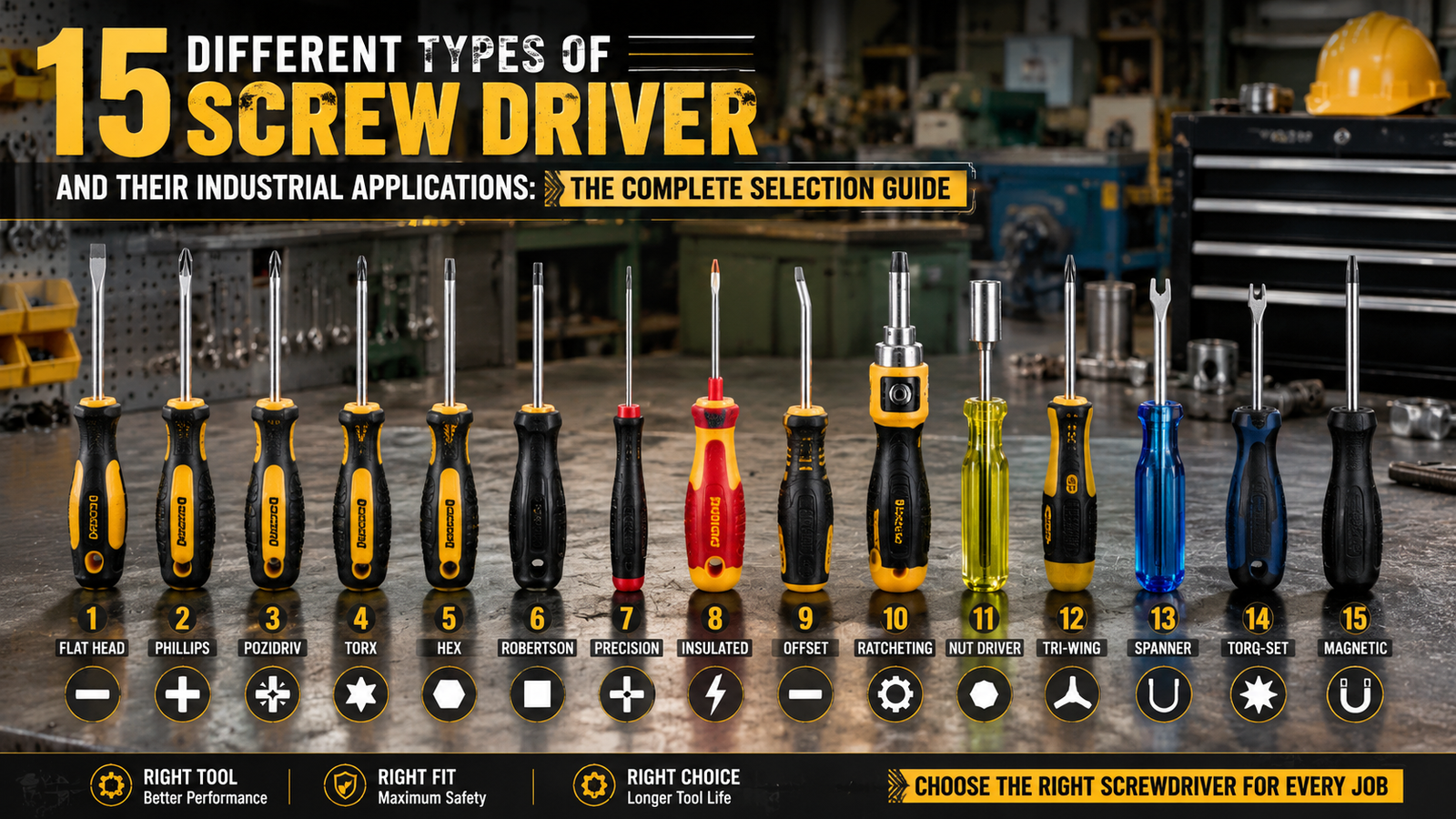
Introduction:
Screw driver are the most frequently reached-for tools in any industrial setting. Walk through any manufacturing plant, electrical panel room, automotive assembly line, or field service truck, and you will find multiple screwdriver types in constant use. From tightening terminal screws inside control panels to removing access covers on production machinery, the right screwdriver is non-negotiable.
The problem is that the wrong screwdriver causes real damage — stripped screw heads, damaged workpieces, stalled production, and in electrical environments, serious safety hazards. Maintenance technicians and engineers who understand the different types of screwdrivers and their correct applications work faster, make fewer mistakes, and keep tools in service longer.
This guide covers 15 screwdriver types used in industrial maintenance, manufacturing, electrical work, and field service. Each section includes practical application details, common industries, size information, and direct technician recommendations drawn from hands-on experience.
📘 Suggested Course: Mechanical Engineering Design – The Ultimate Course
👉 If you want to understand mechanical design principles, engineering calculations, and practical design concepts with real-world industrial applications, this course is highly recommended.
👉 Learn complete mechanical engineering design fundamentals here: [https://trk.udemy.com/Ag326a]
👉 Get full subscription access: https://trk.udemy.com/PzKGrq
1. Flat Head Screwdriver (Slotted Screwdriver):
The flat head screwdriver — also called a slotted screwdriver — is the oldest and most universally recognized driver type. It has a single horizontal blade that fits into a single-slot screw head. Despite being overshadowed by more modern designs, flat head screwdrivers remain essential in industrial maintenance work.
- Industrial Applications: Opening and adjusting terminal screws on electrical equipment, adjusting potentiometers and trim pots on circuit boards, prying or scraping applications, legacy machine maintenance where slotted fasteners are still common, and general disassembly tasks.
- Common Industries: Electrical maintenance, HVAC systems, legacy industrial machinery, plumbing, industrial control panels, and general mechanical maintenance across all sectors.
- Advantages: Versatile, available in every size from micro to industrial-heavy, useful for non-screwdriving tasks such as prying and scraping, universal spare in every tool kit.
- Limitations: High cam-out tendency — the blade slips out of the slot under torque. Requires precise alignment. Low torque transfer efficiency compared to recessed designs. Not suitable for power driver use in most cases.
- Typical Sizes: Blade widths from 1.5 mm (micro) to 12 mm (heavy-duty industrial). Tip thicknesses vary by application. Most common industrial sizes: 3 mm, 5 mm, 6.5 mm, and 8 mm.
- Material Compatibility: Carbon steel and chrome vanadium steel blades. Handles in cellulose acetate, TPR rubber, or fiberglass-reinforced nylon for grip and insulation.
- Technician Recommendation: Always match the blade width as precisely as possible to the slot width. A blade too narrow concentrates force and strips the slot. A blade too wide contacts the workpiece surface and causes damage. For terminal block work, keep a 3-piece set of 3 mm, 5 mm, and 6.5 mm within reach at all times.
2. Phillips Screwdriver:
The Phillips screwdriver is the dominant fastening tool in North American manufacturing and assembly. Designed with a cross-shaped tip that self-centers in the screw recess, it delivers better torque transfer than slotted designs. The cam-out feature — where the tip ejects under excessive torque — was originally intentional to prevent overtightening in assembly lines.
- Industrial Applications: Automotive assembly, electronics manufacturing, consumer goods production, HVAC equipment installation, industrial control cabinet assembly, appliance manufacturing, and structural panel installation.
- Common Industries: Automotive manufacturing, electronics, white goods assembly, general manufacturing, food processing equipment, commercial HVAC, and aerospace assembly.
- Advantages: Self-centering tip speeds assembly work. Excellent compatibility with power drivers and impact drivers. Available at every hardware supply and tool supplier in the US. Multiple sizes cover nearly all standard hardware.
- Limitations: Cam-out occurs before full torque is applied — intentional by design but problematic for high-torque industrial fastening. Phillips does not perform well with worn screw recesses. Not cross-compatible with Pozidriv (a common and costly mistake).
- Typical Sizes: PH0, PH1, PH2, PH3, PH4. PH2 is by far the most common in industrial and manufacturing applications. PH0 for electronics. PH3 and PH4 for heavy structural fasteners.
- Material Compatibility: Chrome vanadium alloy steel tips. Handles in bi-material rubber over polypropylene, or cellulose acetate for electrical work.
- Technician Recommendation: Keep PH1, PH2, and PH3 on the tool belt for any general manufacturing or maintenance environment. Replace Phillips tips when the cross flanks show visible rounding — a worn Phillips tip on a recessed screw will strip the fastener instantly. For high-volume assembly work, use magnetic Phillips bits in a ratcheting driver to maintain speed.
3. Pozidriv Screwdriver:
Pozidriv (often abbreviated PZ) was developed as a direct improvement over Phillips. It features a double-cross design with additional ribs between the four main flanks. This geometry provides greater contact area, significantly reduced cam-out tendency, and more reliable torque transfer. It is the preferred fastener system in European manufacturing and is becoming more common in US industrial equipment imported from European OEMs.
- Industrial Applications: European industrial machinery maintenance, IKEA-style assembly furniture hardware, cabinet manufacturing, structural wood fastening, European automotive assembly lines, and equipment manufactured to DIN or EN standards.
- Common Industries: Furniture manufacturing, European OEM machinery maintenance, cabinetry, wood products, structural assembly, and any facility running European-manufactured production equipment.
- Advantages: Near-zero cam-out under normal torque loads. Superior torque transfer compared to Phillips. Excellent for power driving in production environments. Reduces fastener head damage significantly.
- Limitations: Not widely stocked in all US tool suppliers — plan ahead if maintaining European equipment. Visually similar to Phillips, which causes frequent misidentification. Requires correct PZ size matching for optimal performance.
- Typical Sizes: PZ0, PZ1, PZ2, PZ3. PZ2 is the workhorse size for most structural and furniture applications. PZ3 for heavy timber fasteners.
- Material Compatibility: Chrome vanadium steel tips. Handles same as Phillips — bi-material or cellulose acetate.
- Technician Recommendation: If your facility maintains equipment from European OEMs (Siemens, Festo, Bosch Rexroth, Schneider), stock PZ1 and PZ2 Pozidriv drivers. Mark them clearly — the PZ markings on the handle shank are easy to spot once you know to look. Do not substitute Phillips for Pozidriv, even temporarily.
📘 Suggested Course: The Complete Mechanical Engineering Course – 12 Courses in 1
👉 If you want to build a strong understanding of core mechanical engineering concepts across multiple subjects with real-world engineering applications, this course is highly recommended.
👉 Learn complete mechanical engineering fundamentals here: [https://trk.udemy.com/7XOoP5]
👉 Get full subscription access: https://trk.udemy.com/PzKGrq
4. Torx Screwdriver:
Torx screwdrivers feature a six-pointed star-shaped tip, developed by Camcar Textron. The Torx design completely eliminates cam-out — the tip either drives the fastener or does not engage. This makes it the preferred system for high-torque applications, automotive manufacturing, and anywhere fastener reliability is critical. Tamper-resistant Torx (TR) variants add a center post to prevent unauthorized removal.
- Industrial Applications: Automotive drivetrain and suspension assembly, electronics and hard drive manufacturing, industrial machinery covers and guards, torque-sensitive medical device assembly, heavy equipment maintenance, and anywhere tamper-resistant security fasteners are specified.
- Common Industries: Automotive (OEM and aftermarket), aerospace, electronics, hard drive and data storage manufacturing, heavy equipment, defense manufacturing, and medical device assembly.
- Advantages: Zero cam-out by design. Extremely high torque transfer relative to fastener size. Six contact points distribute stress evenly, preventing fastener head failure. Tamper-resistant variants provide security in public and industrial installations.
- Limitations: Requires exact size matching — no tolerance for using adjacent sizes. Tamper-resistant versions require specific TR bits; standard Torx will not engage. Less common than Phillips in general industrial hardware supply chains.
- Typical Sizes: T6 through T100. Most common industrial sizes: T15, T20, T25, T27, T30, T40, T45. Automotive: T47, T55 for drivetrain work. Electronics: T6, T8, T10.
- Material Compatibility: S2 steel bits for impact driver use. Chrome vanadium for standard hand drivers. Handles in bi-material or TPR rubber.
- Technician Recommendation: Build a complete T10 through T55 set for any automotive or heavy equipment maintenance shop. Do not mix standard Torx and Torx Plus (IPR/IP series) — they look similar but are dimensionally different. Color-code your tamper-resistant bits so they are never grabbed by mistake when standard Torx is needed.
5. Hex Screwdriver (Allen Wrench / Hex Key Driver):
Hex screwdrivers — most commonly recognized as Allen wrenches or hex keys — drive internal hexagonal socket-head fasteners (cap screws, set screws, and grub screws). In industrial maintenance, hex fasteners are found throughout machinery: motor mounts, gearbox covers, bearing housings, and precision equipment. The hex drive provides excellent torque transfer and is compact enough for recessed locations.
- Industrial Applications: Machinery assembly and maintenance, motor and gearbox mounting, CNC machine tool changes, jig and fixture assembly, bearing housing fastening, and any application using socket head cap screws (SHCSs) or set screws.
- Common Industries: Machine shops, manufacturing plants, CNC machining, material handling equipment, robotics, pumps and compressors, conveyor systems, and precision assembly.
- Advantages: High torque transfer in a compact tool profile. Reaches deeply recessed fasteners. Excellent for set screws and grub screws inaccessible with conventional drivers. Available as L-key, T-handle, and bit format for flex ratchets.
- Limitations: Fastener damage (rounding) occurs when using SAE hex keys on metric fasteners or vice versa. Ball-end hex keys allow angular access but reduce torque capacity. Easy to lose the correct size on a busy shop floor.
- Typical Sizes: SAE: 0.050″ through 3/8″. Metric: 1.5 mm through 19 mm. Most common industrial: 4 mm, 5 mm, 6 mm, 8 mm, 10 mm metric; 3/16″, 1/4″, 5/16″ SAE.
- Material Compatibility: Chrome vanadium steel standard. S2 tool steel for impact-rated hex bits. Coatings: black oxide or chrome.
- Technician Recommendation: Keep both metric and SAE hex key sets mounted in the shop. A folding hex key set takes up minimum space on a tool belt. For high-frequency maintenance tasks on the same fasteners, switch to a T-handle hex driver for ergonomic advantage and faster operation. Ball-end hex sets are worth the investment — angular engagement saves time in tight machinery compartments.
6. Robertson Screwdriver (Square Drive):
The Robertson screwdriver uses a square-tipped driver that fits into a square recess in the screw head. Invented by P.L. Robertson in Canada in 1908, this drive system dominates in Canadian manufacturing and is gaining adoption across North America. It has zero cam-out, excellent self-centering properties, and the driver tip can hold the screw without a magnet — useful in tight assembly areas.
- Industrial Applications: Decking, framing, and structural wood construction, furniture manufacturing, cabinet assembly, electrical box assembly, and any production environment where screw retention on the tip is an operational advantage.
- Common Industries: Construction (residential and commercial framing, decking), furniture manufacturing, cabinet production, RV manufacturing, and marine construction.
- Advantages: Zero cam-out by design. Screw stick-fit — the screw stays on the tip without magnets. Excellent for one-handed operation in constrained assembly areas. Highly efficient for power driving in production environments.
- Limitations: Less common than Phillips in US industrial hardware supply chains, though availability has improved. Not ideal for tamper-resistance applications. Size range is narrower than Phillips.
- Typical Sizes: R0, R1, R2, R3. R2 covers the majority of standard construction and cabinet hardware. R1 for small cabinet hardware and electrical fixtures.
- Material Compatibility: Chrome vanadium steel. Handles in TPR or bi-material. Available as square bits for impact and drill drivers.
- Technician Recommendation: If your facility uses any Robertson fasteners — especially in wood products, framing, or cabinetry — stock R1 and R2 in both hand driver and bit format. The one-handed screw placement feature is a genuine time-saver in production assembly. Check fastener specifications on imported Canadian manufacturing equipment.
📘 Suggested Course: Python for Mechanical Engineers
👉 If you want to understand Python programming for engineering calculations, automation, data analysis, and real-world mechanical applications, this course is highly recommended.
👉 Learn practical Python skills for mechanical engineering here: [https://trk.udemy.com/QYn4Dx]
👉 Get full subscription access: https://trk.udemy.com/PzKGrq
7. Precision Screwdriver:
Precision screwdrivers are miniaturized drivers designed for small-scale fastening in electronics, instrumentation, and fine mechanical assemblies. They are typically supplied as sets covering Phillips PH000 through PH1 and slotted sizes from 1 mm to 3 mm. In industrial maintenance, they are essential for work on PLCs, sensors, transmitters, metering equipment, and fine-pitched connector terminal blocks.
- Industrial Applications: PCB assembly and rework, PLC and HMI maintenance, sensor calibration and servicing, instrument panel maintenance, terminal strip adjustment, and jewelry or watch repair where applicable to maintenance scope.
- Common Industries: Electronics manufacturing, process instrumentation, automation and controls, telecommunications equipment, and laboratory instrument maintenance.
- Advantages: Allows safe torque application to delicate fasteners without risk of overtorque damage. Swivel caps on quality sets allow one-finger pressure guidance. Thin, knurled handles provide feedback for exact torque control.
- Limitations: Not suitable for any torque beyond light hand pressure. Tips can deform rapidly if forced. Loss risk is high due to small size — organize in labeled holders.
- Typical Sizes: Blade widths: 1.0 mm to 3.5 mm slotted. Phillips: PH000, PH00, PH0, PH1. Torx: T2 through T10. Sets typically cover 6–30 pieces.
- Material Compatibility: Hardened alloy steel or S2 steel tips for durability at small scale. Handles in aluminum, chrome-plated steel, or high-grip rubber.
- Technician Recommendation: Purchase a quality branded set (Wiha, Vessel, Wera, or Klein Tools) rather than a cheap import. Precision screwdriver tips fail quickly under any misuse, and failure on a live PCB or instrumentation board can cause costly damage. Store in a dedicated labeled roll or holder — losing a 1.5 mm slotted driver in the middle of a maintenance task wastes significant time.
8. Insulated Screwdriver:
Insulated screwdrivers are built specifically for live electrical work. They are manufactured with insulating material — typically molded PVC or multi-layer polymer — covering the blade and handle to prevent current flow to the user. Legitimate insulated screwdrivers carry a 1000V AC rating and are tested to IEC 60900 / NFPA 70E standards. They are not decorative — the insulation is the safety system.
- Industrial Applications: Live panel work, MCC (motor control center) maintenance, switchgear assembly and maintenance, transformer terminal connections, residential and commercial electrical installation, and any work performed on energized equipment where LOTO is not in effect.
- Common Industries: Electrical contractors, industrial electricians, utility workers, panel builders, industrial maintenance electrical teams, and any technician required to work on live equipment under safety permits.
- Advantages: Provides personal protective isolation against electrical shock at rated voltages. Tested and certified to recognized standards. Often available in multiple driver types — slotted, Phillips, and Torx — with insulated handles and blades.
- Limitations: Insulation adds bulk to the blade, which can limit access in tightly packed panels. Heavy in comparison to standard drivers. Must be inspected before every use — damaged insulation renders the tool unsafe. Cost is significantly higher than standard screwdrivers.
- Typical Sizes: Slotted: 2.5 mm to 8 mm. Phillips: PH1, PH2. Specialized sets cover Torx and hex profiles. VDE-rated sets from manufacturers like Wera, Wiha, Knipex, and Fluke cover the common industrial sizes.
- Material Compatibility: Insulated handles and blade coatings in PVC, multi-layer polymer, or VDE-approved materials. Steel blade core rated for torque performance.
- Technician Recommendation: Never assume a standard screwdriver is safe for live electrical work because it has a rubber handle. True insulated screwdrivers are individually tested and stamped with the 1000V double-triangle VDE symbol. Build a dedicated set kept separate from general-use tools. Use visual markers — red handle tape or a separate case — to prevent uninsulated tools from being grabbed during electrical work.
9. Offset Screwdriver:
Offset screwdrivers (also called right-angle screwdrivers) have their tips oriented at 90 degrees to the handle. This allows access to fasteners in locations that are completely inaccessible to standard drivers — inside machine frames, behind structural members, beneath motor covers, and in confined assembly spaces. They work by a ratcheting or flip-over motion.
- Industrial Applications: Fastener access in deep recesses, machinery frame assembly and disassembly, appliance repair in tight cabinets, aircraft maintenance in confined fuselage areas, and automotive underbody work where standard tools cannot reach.
- Common Industries: Automotive repair and manufacturing, aerospace maintenance, appliance repair, HVAC equipment service, and heavy industrial machinery maintenance.
- Advantages: Solves access problems that would otherwise require partial disassembly of equipment. Compact form factor for tight spaces. Ratcheting versions allow continuous rotation without repositioning the tool.
- Limitations: Low torque capacity compared to standard screwdrivers. Awkward to use — requires practice. Limited to light torque applications. Risk of slippage in confined spaces without full handle control.
- Typical Sizes: Typically 4″ to 8″ overall length. Available in slotted, Phillips, and combination blade formats. Ratcheting offset drivers offer greater speed in accessible confined spaces.
- Material Compatibility: Chrome vanadium steel blades. Handles in chrome-plated steel, rubber-overmolded steel, or hard plastic.
- Technician Recommendation: Stock one combination offset screwdriver (slotted / Phillips) in every field service kit. For regular confined-access maintenance tasks on specific equipment, identify the fastener type and keep a dedicated offset driver in the service kit for that machine. Ratcheting models are worth the added cost for high-frequency confined-access work.
📘 Suggested Course: Machine Design Basics – I – Shaft, Bearings & Gears
👉 If you want to understand shaft design, bearing selection, gear fundamentals, and machine design concepts with real-world engineering applications, this course is highly recommended.
👉 Learn complete machine design fundamentals here: [https://trk.udemy.com/E0eJBQ]
👉 Get full subscription access: https://trk.udemy.com/PzKGrq
10. Ratcheting Screwdriver:
Ratcheting screwdrivers use an internal ratchet mechanism to drive screws continuously without removing and repositioning the hand. Most accept interchangeable bits, making them multi-drive tools for production and maintenance work. The handle can be switched between clockwise ratchet, counterclockwise ratchet, and locked modes. Ratcheting drivers have become a standard productivity tool in assembly and maintenance environments.
- Industrial Applications: Production line assembly, preventive maintenance tasks, electrical panel wiring, multi-fastener disassembly and reassembly operations, and any repetitive screwdriving task where repositioning time affects productivity.
- Common Industries: Manufacturing assembly, industrial maintenance, electrical installation, MRO (maintenance, repair, and operations) teams, and field service.
- Advantages: Significant productivity improvement over standard screwdrivers in multi-fastener tasks. Accepts interchangeable bits — covers all drive types with one handle. Reduces hand fatigue in repetitive operations. Many models include bit storage in the handle.
- Limitations: Ratchet mechanism adds complexity and potential failure points. Not suitable for final precision torque applications without torque verification. Ratchet can slip in reverse under heavy loads if not properly locked.
- Typical Sizes: Handle diameter typically 1″ to 1.5″. Bit capacity: standard 1/4″ hex shank bits. Overall length: 7″ to 10″. Stubby ratcheting drivers available for confined space work (3″ to 4″ overall length).
- Material Compatibility: Die-cast zinc or chrome vanadium steel internals. Handles in bi-material rubber-over-polypropylene or cellulose acetate.
- Technician Recommendation: A quality ratcheting driver with a full bit set is one of the highest-productivity investments for any maintenance technician. Look for models with a quick-change bit chuck and positive-lock ratchet direction switch — these features directly affect usability in real maintenance tasks. Keep a stubby ratcheting driver in the tool bag for panel work.
11. Nut Driver:
Nut drivers look like screwdrivers but drive hexagonal nuts and bolt heads rather than screw recesses. They have a hollow or solid hexagonal socket tip that fits over the fastener. In industrial maintenance, nut drivers are used constantly for small hardware — terminal lugs, grounding lugs, enclosure fasteners, and hex-head sheet metal screws used in HVAC and panel construction.
- Industrial Applications: Electrical panel assembly and maintenance, HVAC equipment fastening, terminal lug tightening, enclosure assembly, sheet metal work with hex-head screws, and any fastening application using small hex-head hardware.
- Common Industries: Electrical contractors, HVAC technicians, panel builders, sheet metal fabricators, and industrial maintenance electrical teams.
- Advantages: Faster than a wrench for small hex fasteners. Provides good tactile control for terminal work. Available in sizes matching standard hardware. Hollow-shaft models allow bolt pass-through for longer studs.
- Limitations: Limited torque compared to wrench or socket set. Not suitable for hex fasteners requiring significant clamping torque. Hollow shaft can crack under excessive side load.
- Typical Sizes: Most common: 1/4″, 5/16″, 3/8″, 7/16″, 1/2″ SAE. Metric: 5 mm, 5.5 mm, 6 mm, 7 mm, 8 mm, 10 mm. Sets of 7–9 pieces cover the majority of industrial applications.
- Material Compatibility: Chrome vanadium steel sockets. Handles in cellulose acetate, bi-material rubber, or insulated PVC for electrical work.
- Technician Recommendation: Keep a 7-piece nut driver set in every electrical maintenance kit. The 1/4″ and 5/16″ drivers are the most heavily used — buy individually replaceable versions, or keep spares. For panel work and terminal maintenance, insulated nut drivers rated to 1000V are available and should be the standard specification.
12. Tri-Wing Screwdriver:
The Tri-Wing screwdriver has a three-pronged tip designed for a triangular three-wing recess found on tamper-resistant fasteners. These screws appear on aviation components, Nintendo gaming hardware, and certain consumer electronics. In industrial settings, Tri-Wing fasteners are primarily encountered on airline seat components, avionics enclosures, and specialized electronics housings.
- Industrial Applications: Aviation seat mechanism maintenance, avionics and aircraft interior assembly, Nintendo and gaming console repair, and specialized consumer electronics servicing where Tri-Wing security screws are specified.
- Common Industries: Aviation MRO (maintenance, repair, overhaul), aerospace component manufacturing, electronics repair facilities, and gaming console service centers.
- Advantages: Provides tamper resistance — prevents unauthorized opening of aviation and consumer hardware. Precise three-point engagement distributes torque evenly.
- Limitations: Highly specialized — not found in general industrial hardware. Limited size range. No substitution possible with standard tools.
- Typical Sizes: TWI-0, TWI-1, TWI-2. TWI-1 covers most aviation seat components. TWI-0 for small electronics.
- Material Compatibility: Hardened alloy steel. Handles standard bi-material or precision knurled format.
- Technician Recommendation: Stock Tri-Wing drivers only if your facility performs aviation MRO work or handles electronics repair involving Nintendo or specific consumer hardware. Attempting to use a standard driver on a Tri-Wing recess will destroy the fastener — there is no alternative tip geometry that works.
📘 Suggested Course: Learn All About Rolling Contact Bearings and Its Selection
👉 If you want to understand rolling contact bearing types, selection methods, and performance factors with real-world industrial applications, this course is highly recommended.
👉 Learn complete bearing fundamentals and selection concepts here: [https://trk.udemy.com/9Vzz4e]
👉 Get full subscription access: https://trk.udemy.com/PzKGrq
13. Spanner Screwdriver:
Spanner screwdrivers (also called snake-eye or bimane drivers) have a tip with two parallel pins that fit into two small holes in a spanner screw head. Spanner screws are high-security fasteners used to prevent unauthorized access on public fixtures, elevators, transit equipment, utility enclosures, and commercial restroom hardware.
- Industrial Applications: Elevator maintenance and inspection, transit vehicle maintenance, utility enclosure access, commercial restroom fixture service, public fixture maintenance, and security hardware installation.
- Common Industries: Building maintenance, elevator service companies, transit authority maintenance teams, utility companies, and public infrastructure maintenance contractors.
- Advantages: Provides access to high-security fasteners without damaging them. Required for compliance with manufacturer service procedures on security hardware.
- Limitations: Extremely specialized. Pin diameter and spacing must match exactly — no tolerance for variation. Not widely available in standard tool supply chains.
- Typical Sizes: Size #6, #8, #10 spanner. Pin spacing typically 1/16″ to 3/8″ depending on fastener size.
- Material Compatibility: Hardened alloy steel pins. Handles in standard polypropylene or bi-material.
- Technician Recommendation: If your facility or service contract includes elevator maintenance, transit vehicle maintenance, or public infrastructure work, build a spanner driver set and keep it with the service vehicle. Spanner fasteners are always encountered unexpectedly — a missing driver at the job site means an aborted service call.
14. Torq-Set Screwdriver:
Torq-Set screwdrivers drive a specialized cross-recess fastener used almost exclusively in aerospace and military aviation applications. The Torq-Set recess looks similar to Phillips but has offset cross slots — the driver flanks are not aligned at right angles but are staggered. This design provides additional resistance to cam-out and is specified in US military and aerospace fastener standards.
- Industrial Applications: Military aircraft maintenance (MIL-SPEC), aerospace structural assembly, defense contractor manufacturing, and specific US Navy and Air Force maintenance operations.
- Common Industries: Aerospace OEM manufacturing, military aviation MRO, defense maintenance depots, and aerospace structural assembly.
- Advantages: Near-zero cam-out in precision fastening applications. Required for MIL-SPEC fastener compliance. Distributes torque across offset flanks for reliable high-torque driving.
- Limitations: Extremely specialized — aerospace and defense only. Not found outside of aviation MRO. Very limited commercial availability. Requires exact driver sizing.
- Typical Sizes: Sizes 1 through 4. Sizes 1 and 2 cover most aerospace applications.
- Material Compatibility: S2 and alloy steel tips. Handles in aviation-grade materials meeting MIL-spec requirements where applicable.
- Technician Recommendation: Stock Torq-Set drivers only if your facility performs MIL-SPEC or aerospace MRO work. Verify your fastener specifications before ordering — Torq-Set fasteners are easy to confuse with Phillips in dim lighting. Any aviation or defense maintenance facility should include Torq-Set in the standard tool kit for aircraft access panels.
15. Magnetic Screwdriver:
Magnetic screwdrivers are not a separate drive type — any flat head, Phillips, Torx, or hex driver can be magnetized. The magnet at the tip holds the screw on the driver during placement, which is critical when working in tight spaces, overhead applications, or anywhere dropping a screw creates a serious problem. Many industrial-grade screwdrivers are manufactured with permanent magnetic tips, and magnetic tip tools can also be created using a tip magnetizer.
- Industrial Applications: Overhead and inverted maintenance work, electrical panel wiring where dropped screws cause hazards, precision assembly where dropped fasteners damage components, any task requiring one-handed screw placement in tight access areas.
- Common Industries: Electrical maintenance, electronics assembly, overhead mechanical work, field service, and production assembly across all industrial sectors.
- Advantages: Eliminates screw-holding hand in tight spaces. Prevents dropped fasteners from falling into machinery, electrical panels, or moving parts. Speeds up assembly in one-handed operation scenarios.
- Limitations: Magnet must be avoided near magnetically sensitive components — hard drives, magnetic sensors, MRI-adjacent environments, and certain electronic assemblies. Magnet strength degrades over time with heat and impact exposure. A strong magnet can make it difficult to control screw placement in tight clusters.
- Typical Sizes: Not a separate size category — magnetism is a feature added to any driver tip. Magnetizer/demagnetizer blocks cost under $15 and should be in every tool kit.
- Material Compatibility: Chrome vanadium or S2 steel tips with retained magnetism. Ceramic or neodymium magnet rings added to some professional-grade handles.
- Technician Recommendation: Invest in a tip magnetizer and demagnetizer tool — they allow any standard driver to be magnetized on demand and demagnetized when working near sensitive components. For electrical panel work, magnetic drivers are a productivity essential. Replace heavily used magnetic drivers when tip magnetism weakens noticeably — a weak magnet is worse than no magnet for fine fastener placement.
📘 Suggested Course: Geometric Dimensioning and Tolerancing (GD&T) – Basics
👉 If you want to understand GD&T fundamentals, engineering drawing symbols, tolerancing methods, and practical design concepts with real-world engineering applications, this course is highly recommended.
👉 Learn complete GD&T fundamentals here: [https://trk.udemy.com/aNA2Mo]
👉 Get full subscription access: https://trk.udemy.com/PzKGrq
Quick Reference Tables:
Screwdriver Type | Common Problems | Recommended Solution:
| Screwdriver Type | Common Problem | Recommended Solution |
| Flat Head | Slips out of slot under torque | Match blade width exactly to slot; use tapered blade |
| Phillips | Cam-out on worn recesses | Replace tip; use Pozidriv if available on same screw size |
| Pozidriv | Confused with Phillips | Mark handles; train staff on visual identification |
| Torx | Wrong size causes slip and damage | Build complete T6–T55 set; size-check before every use |
| Hex | SAE/metric cross-use rounding | Keep SAE and metric sets clearly separated and labeled |
| Robertson | Overdriving in soft materials | Use torque-limiting bit or depth-stop drill bit |
| Precision | Tip breakage on small fasteners | Never force; replace worn tips immediately |
| Insulated | Insulation damage goes undetected | Pre-use visual inspection every session; retire damaged tools |
| Offset | Slippage in confined space | Ensure full blade seat; use ratcheting offset for control |
| Ratcheting | Ratchet slip under high torque | Lock to fixed mode for final torque; verify mechanism before use |
| Nut Driver | Shaft cracking under side load | Never use as pry; apply only axial torque |
| Magnetic | Magnet weakens over time | Test magnetism regularly; re-magnetize with tip magnetizer block |
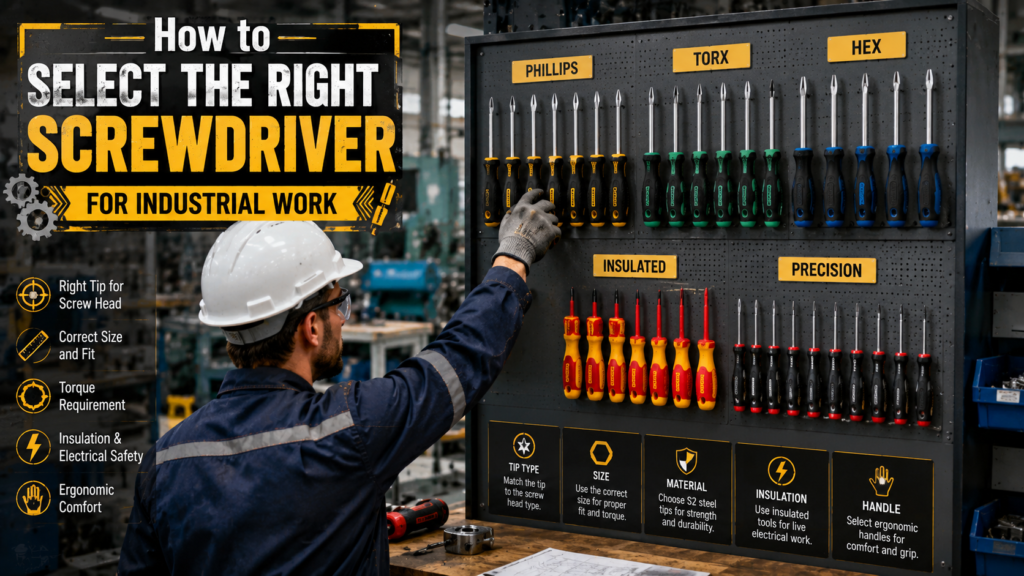
How to Select the Right Screwdriver for Industrial Work:
Selecting the correct screwdriver for an industrial application is not complicated, but it requires attention to several factors. Getting this wrong costs time, damages tools and fasteners, and in electrical environments, risks personnel safety.
1. Screw Head Compatibility:
- This is the non-negotiable first step. Identify the fastener drive type before picking up a tool. Use a fastener identification card if necessary — they are available from most industrial tool suppliers for under $5. A Phillips look-alike Pozidriv fastener will destroy both the tip and itself if driven with the wrong driver.
2. Torque Requirements:
- Hand screwdrivers are sufficient for most maintenance and assembly applications up to approximately 15–20 Nm. Above that, transition to a torque wrench, torque-limiting driver, or impact driver rated for the application. Never estimate torque on structural or safety-critical fasteners — verify the specification and use calibrated tools.
3. Handle Material and Ergonomics:
- In production environments and extended maintenance sessions, handle ergonomics directly affect fatigue and injury risk. Tri-lobular or contoured handles reduce torque effort compared to round handles. Bi-material rubber-over-polypropylene provides grip in oily or wet conditions. For electrical work, the handle insulation rating is the primary specification — not the grip feel.
📘 Suggested Course: Valve & Control Valve Masterclass – Design, Selection & Sizing
👉 If you want to understand valve types, control valve design, selection methods, and sizing techniques with real-world industrial applications, this course is highly recommended.
👉 Learn complete valve engineering fundamentals here: [https://trk.udemy.com/3kZogk]
👉 Get full subscription access: https://trk.udemy.com/PzKGrq
4. Electrical Safety Requirements:
- If there is any possibility of contact with energized conductors, the tool must be rated and certified to IEC 60900 or ASTM F1505 at 1000V AC minimum. This applies to all driver types — flat head, Phillips, hex, nut driver. Do not use unrated tools on live equipment under any circumstances, regardless of perceived safety.
5. Material Strength and Tip Hardness:
- For general maintenance, chrome vanadium steel is adequate. For impact driver use, S2 steel bits or impact-rated bits are required — standard chrome vanadium bits shatter in impact drivers. For stainless steel fasteners, use tips with a black oxide or titanium nitride coating to reduce galling. In corrosive environments (chemical plants, marine, food processing), look for chrome-plated or stainless-tipped drivers.
6. Maintenance Requirements:
- Tools in industrial environments require regular inspection. Tip wear is the primary failure mode for all drive types. A worn tip is not a minor inconvenience — it is a tool that actively damages fasteners and should be removed from service. For insulated drivers, pre-use inspection is mandatory every session. For ratcheting drivers, periodically clean the ratchet mechanism — debris accumulation is the primary cause of ratchet slippage.
Frequently Asked Questions:
Q1: What is the most commonly used screwdriver type in industrial maintenance?
- Phillips PH2 is the most frequently used screwdriver in North American industrial maintenance. It covers the majority of standard hardware in manufacturing, electrical panels, HVAC equipment, and general machinery. Torx T25 and T30 are close behind in automotive and heavy equipment applications.
Q2: What is the difference between a Phillips and a Pozidriv screwdriver?
- Phillips (PH) has four flanks meeting at right angles. Pozidriv (PZ) has the same four flanks plus four additional ribs between them, creating eight contact points. Phillips is designed to cam out under excess torque. Pozidriv resists cam-out and transfers more torque to the fastener. They are not interchangeable — using Phillips on Pozidriv fasteners damages both the driver and the screw head.
Q3: Are insulated screwdrivers safe for working on live 480V panels?
- Yes, if the screwdriver carries a verified IEC 60900 or ASTM F1505 rating for 1000V AC. Standard VDE-rated insulated screwdrivers are tested at 10,000V and rated for 1000V use, which covers 480V industrial applications. However, insulated tools are one layer of protection. NFPA 70E requires an arc flash hazard analysis, appropriate PPE, and other safety controls in addition to insulated tools for energized panel work.
Q4: How do I know when a screwdriver tip needs to be replaced?
- Compare the tip against a new driver of the same type. Phillips tips show rounded flanks — the cross profile should have sharp, flat faces. Torx tips show rounded star points. Flat head tips widen and lose edge definition. Functionally, if the driver seats loosely in the fastener recess or tends to cam out at lower torque than expected, the tip is worn and should be replaced.
Q5: Can I use a regular screwdriver with a rubber handle for electrical work?
- No. A rubber handle is not an insulated handle. IEC 60900-rated insulated screwdrivers are manufactured with a specific multi-layer insulation system, individually tested, and stamped with the 1000V rating mark (double-triangle symbol). Rubber-handled standard screwdrivers provide no verified protection against electrical shock. Using them on live circuits creates a serious safety and liability exposure.
Conclusion:
The different types of screwdrivers used in industrial maintenance cover a wide range of drive systems, each engineered for specific applications and torque requirements. From the flat head driver handling legacy terminal screws to the Torq-Set meeting aerospace MIL-SPEC standards, correct tool selection determines whether a maintenance task goes smoothly or creates additional problems.
The practical rules are straightforward: identify the fastener type before picking up a tool, match the driver size precisely, inspect tips before use, maintain insulated tools as safety-critical equipment, and replace worn drivers before they cause damage. A well-organized industrial screwdriver set built around the specific fastener types in your facility is one of the most direct investments in maintenance efficiency available.
Use the tables in this guide as a field reference when selecting screwdrivers for specific industrial applications. Review your current tool inventory against your facility’s fastener specifications and address any gaps before they become mid-shift production problems.