If you work in a plant, refinery, food processing facility, or any industrial setting that runs on steam, you already know how central your boiler system is to the entire operation. When it runs well, everything else runs well. When it doesn’t, the consequences can be costly — unplanned shutdowns, skyrocketing fuel bills, safety violations, and expensive emergency repairs.
Yet, despite how critical industrial steam boilers are, proper training for the people who operate and maintain them is still overlooked at too many facilities across the United States.
This guide is for engineers, plant managers, maintenance supervisors, and industrial technicians who want real answers — not vague advice. We’ll walk through what proper steam boiler operation and maintenance training looks like, how it directly cuts costs, what US safety standards require, and how to find the right certified training program for your team.
📘 Suggested Course: Steam Boilers, Steam & Condensate Systems – 16 Hour Masterclass
👉 If you want to understand steam boiler operation, steam distribution, condensate recovery, and energy efficiency techniques with real-world industrial applications, this course is highly recommended.
👉 Learn complete steam system fundamentals here: [https://trk.udemy.com/dyGRo3]
What Is Industrial Steam Boiler Operation & Maintenance Training?
At its core, boiler training teaches workers how to safely operate, inspect, troubleshoot, and maintain steam boiler systems used in industrial settings.
These aren’t simple systems. Industrial steam boilers involve high-pressure water, combustion systems, heat exchangers, control valves, feedwater systems, and safety devices — all working together. A small gap in knowledge can lead to big problems.
A quality training program typically covers:
- How steam is generated and distributed through a plant
- Boiler startup, shutdown, and emergency procedures
- Reading and interpreting pressure gauges, water levels, and controls
- Routine maintenance tasks and inspection protocols
- Steam boiler water treatment and blowdown procedures
- Identifying and responding to efficiency losses
- Compliance with OSHA, ASME, and National Board standards
Training can be delivered in-person at your facility, through a certified trade school, or via a combination of classroom instruction and hands-on practice. Many programs lead to a boiler operator license or boiler technician certification, which is required in most united states.
Why Boiler Training Is Critical for Cost Reduction:
Let’s be direct: most industrial boiler inefficiencies are preventable. And prevention starts with knowledgeable people.
Here’s what untrained or undertrained staff actually costs facilities each year:
- Excess fuel consumption — A boiler running even 5–10% below efficiency can cost tens of thousands of dollars in extra natural gas or fuel oil annually, depending on plant size.
- Unplanned downtime — Emergency repairs average two to three times more than planned maintenance, and production losses can dwarf the repair cost itself.
- Water and chemical waste — Improper boiler water treatment causes scale buildup, corrosion, and tube failures. Steam boiler water treatment is one of the most overlooked — and most impactful — maintenance activities.
- Shortened equipment lifespan — Poor maintenance accelerates wear. A boiler that should last 25–30 years may need early replacement if it’s not properly cared for.
Trained operators catch these issues early. They know what to look for during daily rounds, understand what changed readings mean, and can make smart adjustments before small problems become expensive ones.
The ROI on professional boiler training programs is real. Many facilities report saving $30,000 to $100,000+ annually after investing in proper operator training — especially in larger plants running multiple boilers.
📘 Suggested Course: Steam Boilers – Principles, Operations, Design & Control
👉 If you want to understand steam boiler working principles, operation, design concepts, and control systems with real-world industrial applications, this course is highly recommended.
👉 Learn complete boiler engineering fundamentals here: [https://trk.udemy.com/xJZn9x]
Key Components Covered in Boiler Training Programs:
A solid training curriculum doesn’t just teach workers to “turn it on and leave it running.” Here’s what a comprehensive industrial steam boiler training program should include:
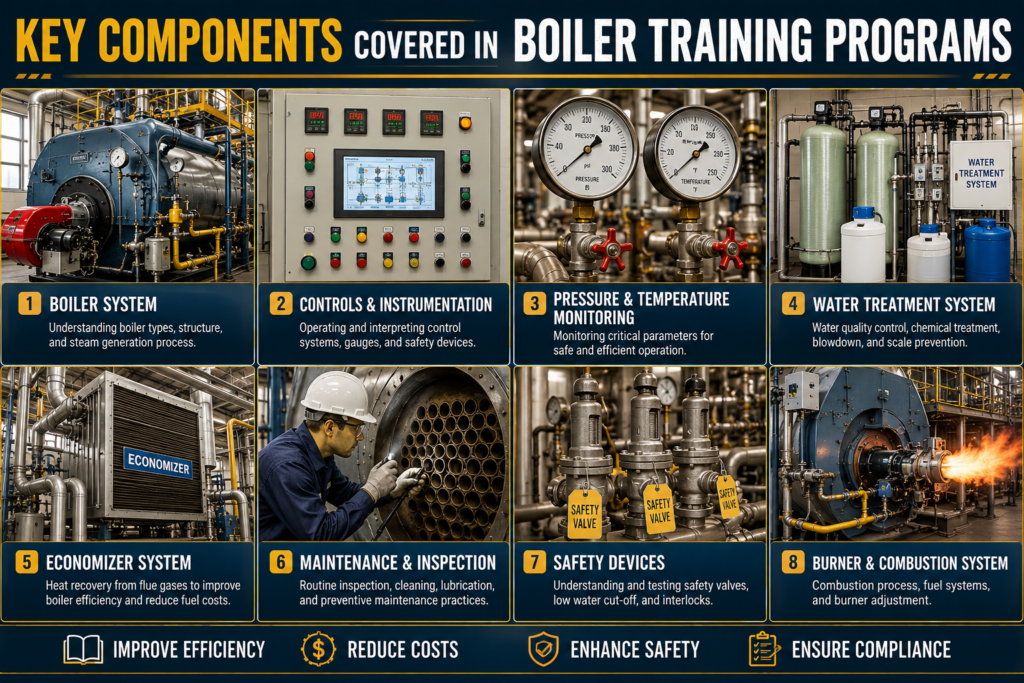
1. Boiler Fundamentals and System Design:
- Understanding how a fire-tube or water-tube boiler works — and the difference between the two — sets the foundation for everything else. Trainees learn about combustion, heat transfer, steam pressure, and how boiler capacity is rated.
2. Controls and Instrumentation:
- Modern boilers use automated controls, safety interlocks, and PLC-based systems. Training covers how to read and interpret these controls, set safe operating limits, and respond when alarms trigger.
3. Steam Boiler Water Treatment:
- This is where a lot of facilities lose money without realizing it. Scale buildup from untreated water reduces heat transfer efficiency significantly. Even a 1/16-inch layer of scale can increase fuel consumption by over 10%. Proper blowdown schedules, chemical treatment, and water testing are all part of this training.
4. Steam Boiler Maintenance Checklist Execution:
- Trainees learn how to carry out daily, weekly, monthly, and annual maintenance tasks. This includes inspecting burner components, testing safety valves, checking water levels, and logging operating data.
📘 Suggested Course: Valve & Control Valve Masterclass – Design, Selection & Sizing
👉 If you want to understand valve types, control valve design, proper selection, and sizing techniques with real-world industrial applications, this course is highly recommended.
👉 Learn complete valve engineering fundamentals here: [https://trk.udemy.com/jRm1WM]
5. Steam Boiler Troubleshooting:
- When something seems off — unusual noise, erratic pressure, higher-than-normal stack temperature — a trained operator knows what to investigate. Troubleshooting training builds that diagnostic instinct.
6. Steam Boiler Economizer Systems:
- An economizer recovers heat from flue gases to preheat feedwater, improving overall boiler efficiency. Many operators don’t receive training on how to maintain or optimize these systems. Good programs cover economizer inspection, cleaning, and performance monitoring.
7. Emergency Response and Safety Procedures:
- Boiler explosions and fires are rare but catastrophic when they happen. Training covers ASME Boiler and Pressure Vessel Code requirements, emergency shutdown procedures, and how to respond to fuel leaks, burner failures, or dangerously low water conditions.
Common Boiler Efficiency Problems and How Training Solves Them:
Let’s look at real problems that trained staff can identify and correct — problems that silently drain your budget when left unaddressed.
Problem: High Stack Temperature: A flue gas temperature that’s too high means heat is escaping up the stack instead of being transferred to the water. Trained operators know how to identify this, check the heat transfer surfaces for fouling, and take corrective action.
Problem: Poor Combustion Efficiency: Improper air-to-fuel ratios waste fuel and can increase harmful emissions — putting you at risk with EPA air quality standards. Operators trained in combustion analysis can adjust burner settings to hit optimal efficiency.
Problem: Excessive Blowdown: Some operators blow down too frequently or for too long, wasting treated hot water and the energy it carries. Training teaches the correct intervals and methods, reducing heat loss and chemical costs.
Problem: Scale and Corrosion: Both problems stem directly from inadequate steam boiler water treatment. Scale reduces efficiency; corrosion causes tube failures and leaks. Training on water testing, treatment, and blowdown prevents both.
Problem: Ignored Alarms and Trends: Untrained staff sometimes reset alarms without understanding what triggered them. Trained operators document and investigate every alarm — catching early signs of equipment failure before it escalates.
📘 Suggested Course: Process Control & Instrumentation – 16 Hour Masterclass
👉 If you want to understand process control fundamentals, instrumentation systems, and control strategies with real-world industrial applications, this course is highly recommended.
👉 Learn complete process control and instrumentation concepts here: [https://trk.udemy.com/1G7brD]
How Proper Maintenance Reduces Fuel and Repair Costs:
Maintenance is not just about avoiding breakdowns. It’s a direct lever on your operating costs.
Here’s how a structured boiler maintenance program saves money:
- Regular burner tuning: keeps combustion efficiency at its peak, reducing fuel cost by 3–8% in many cases.
- Heat exchanger cleaning: prevents scale from insulating heat transfer surfaces, keeping efficiency high.
- Safety valve testing: ensures your relief valves will actually work in an emergency — and avoids fines during boiler inspection services visits.
- Feedwater pump maintenance: prevents failures that can starve the boiler of water — one of the most dangerous and expensive events in boiler operation.
- Insulation checks: on steam lines and fittings reduce distribution losses that most plant managers don’t even know they’re experiencing.
Planned maintenance also makes steam boiler repair events far less frequent and far cheaper when they do occur. A planned tube replacement during a scheduled shutdown costs a fraction of what an emergency repair costs during peak production.
Safety Standards and Compliance in the US:
Boiler safety in the United States is governed by a set of well-established standards and regulatory bodies. Understanding these is part of every good training program.
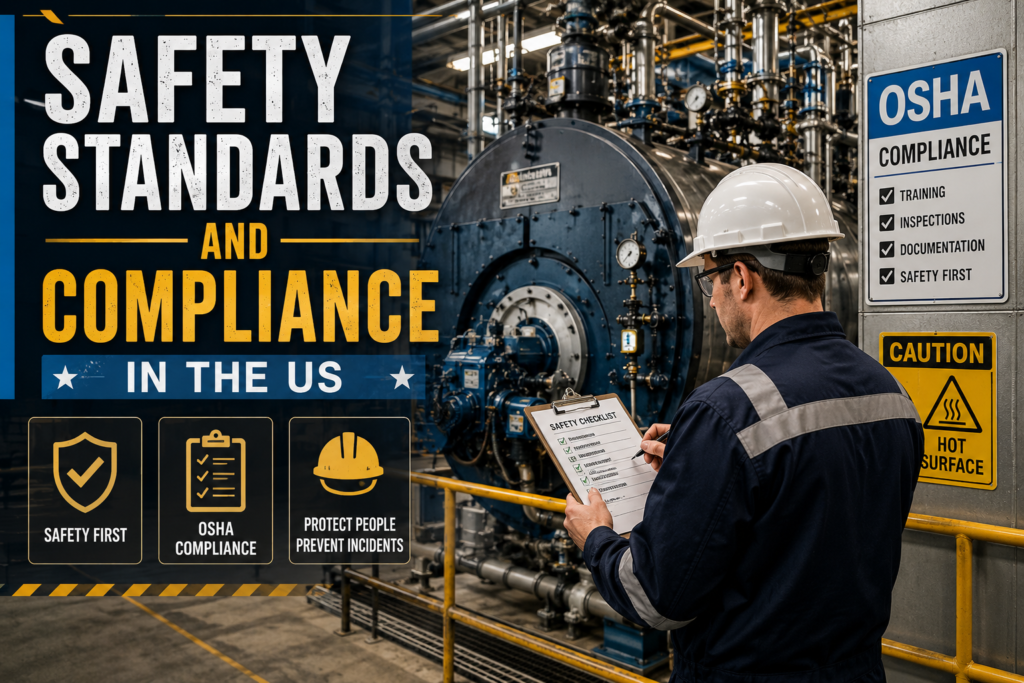
ASME Boiler and Pressure Vessel Code (BPVC): The ASME BPVC is the foundational standard for design, fabrication, and inspection of boilers and pressure vessels. Most US states adopt it by reference in their boiler safety laws.
National Board of Boiler and Pressure Vessel Inspectors: The National Board administers certification for boiler inspectors and maintains records of boiler registrations and repairs. Steam boiler inspection services conducted by National Board-commissioned inspectors are required in most states.
OSHA Standards: OSHA’s General Industry standards (29 CFR 1910) cover safe operation of boilers. OSHA can cite facilities for unqualified operators, lack of documented procedures, missing safety device maintenance, and other gaps — with fines that can reach into the thousands per violation.
EPA Regulations: For facilities burning natural gas, fuel oil, or other fuels, EPA air quality rules under the Clean Air Act apply. Improper combustion can increase NOx and CO emissions, triggering compliance issues.
Certified boiler training programs ensure your operators and technicians understand these requirements — not just in theory, but in their day-to-day work. This is especially important before a boiler inspection services visit, where gaps in documentation or operator knowledge can lead to violations.
📘 Suggested Course: Power Generation – Complete Guide to Power Plants & Turbines
👉 If you want to understand power plant systems, turbine operations, and power generation concepts with real-world industrial applications, this course is highly recommended.
👉 Learn complete power generation fundamentals here: [https://trk.udemy.com/zz4jN0]
Benefits of Certified Boiler Training Programs:
There’s a real difference between a one-day overview session and a certified boiler training course. Certified programs offer:
- Structured curriculum aligned with ASME, OSHA, and National Board standards
- Hands-on practice on real or simulated boiler systems
- Documented competency — a paper trail that matters during audits and inspections
- License preparation for states requiring licensed boiler operators
- Ongoing education to keep up with changes in equipment, technology, and regulation
For plant managers, sending staff through a certified training program also reduces liability. If an incident occurs, documented training records show that your facility took reasonable steps to qualify your operators — which matters for OSHA investigations and insurance purposes.
Many cost-saving solutions in industrial plants don’t require capital investment. Certified operator training is one of them.
Real-World Use Case: Food Processing Plant in the Midwest:
Consider a mid-sized food processing facility in Ohio running three fire-tube boilers. The plant employed several operators, but formal training was limited to brief on-the-job instruction from other operators.
Over time, the plant’s fuel bills crept up. A boiler inspection services visit flagged scaling in one boiler and a mistuned burner on another. The facility was also cited for missing safety valve test records.
Management enrolled four operators in a certified industrial steam boiler training program. After completing the course:
- Operators implemented a proper steam boiler water treatment schedule, reducing scale buildup significantly.
- Burner tuning was corrected, improving combustion efficiency.
- A steam boiler maintenance checklist was established and documented for all three units.
- Safety valve testing was scheduled and logged, bringing the facility into compliance.
Within 12 months, the facility estimated fuel savings of approximately $42,000 annually and avoided a potential OSHA fine. The total training investment was a fraction of those savings.
This kind of result is common when facilities commit to proper operator education.
📘 Suggested Course: Design of Piping Systems – Steam & Condensate
👉 If you want to understand steam and condensate piping design, system layout, and best practices with real-world industrial applications, this course is highly recommended.
👉 Learn complete piping design fundamentals here: [https://trk.udemy.com/bkV7ag]
Tips to Choose the Right Boiler Training Program:
Not all training programs are created equal. Here’s what to look for when evaluating professional training programs for your team:
1. Look for accreditation and alignment with industry standards: Good programs reference ASME, National Board, and OSHA standards explicitly. Ask the training provider which standards their curriculum is built around.
2. Check for hands-on components: Classroom theory is valuable, but operators need to practice what they learn. Programs with lab components or live boiler systems are significantly more effective.
3. Verify instructor credentials: Your instructors should have actual field experience as steam boiler technicians, operators, or inspectors — not just academic backgrounds.
4. Ask about state licensing preparation: If your state requires licensed boiler operators, confirm the program prepares students for the relevant exam.
5. Consider customized on-site training: For larger facilities, some training providers will come to your plant and tailor instruction to your specific equipment. This is especially useful for steam boiler troubleshooting and steam boiler installation orientation after new equipment is added.
6. Confirm training documentation: You need completion certificates and records. This protects you during audits and is required in some states.
7. Evaluate ongoing support: The best providers offer refresher courses, updated materials as standards change, and resources for newly hired technicians.
Conclusion:
Industrial steam boilers don’t run themselves. Behind every efficient, safe, and cost-effective boiler system is a team of trained operators and technicians who understand what they’re working with.
The cost of skipping proper training is not zero — it shows up in your fuel bills, your repair invoices, your inspection reports, and in rare but catastrophic safety incidents. The good news is that the investment in certified boiler training programs pays back quickly and continues to pay back every year afterward.
Whether you’re managing a single boiler or an entire plant utility system, getting your team properly trained is one of the most practical cost-saving solutions available to you — no capital project required.
If you’re ready to reduce fuel costs, strengthen your compliance posture, and extend the life of your equipment, start by evaluating your team’s current training gaps and finding a professional training program that meets US industry standards.