Introduction:
If you work in a plant, a water treatment facility, or anywhere with pipelines, you have probably seen industrial butterfly valves in action. They are one of the most common flow control devices used across industries. Simple in design, easy to operate, and surprisingly effective — these valves do a lot of quiet, important work.
In this guide, I will teach you through how industrial butterfly valves work, what their parts do, and how to keep them running well. Whether you are a maintenance technician or a junior engineer, this guide is written in simple language.
📘 Suggested Course: Valve & Control Valve Masterclass: Design Selection & Sizing
👉 If you want to clearly understand valve types, control valve selection, and sizing calculations used in real industrial applications, this course is highly recommended.
👉 Learn practical valve engineering here: [https://trk.udemy.com/5k7123]
What Is an Industrial Butterfly Valve?
- A butterfly valve is a quarter-turn valve used to start, stop, or control the flow of a fluid through a pipe. The name comes from the way the disc inside opens and closes — it rotates like butterfly wings.
- It is fast to operate. A 90-degree turn of the handle or actuator either fully opens or fully closes the valve. This makes it ideal for situations where you need quick shutoff.
Butterfly Valve Parts — Explained Simply:
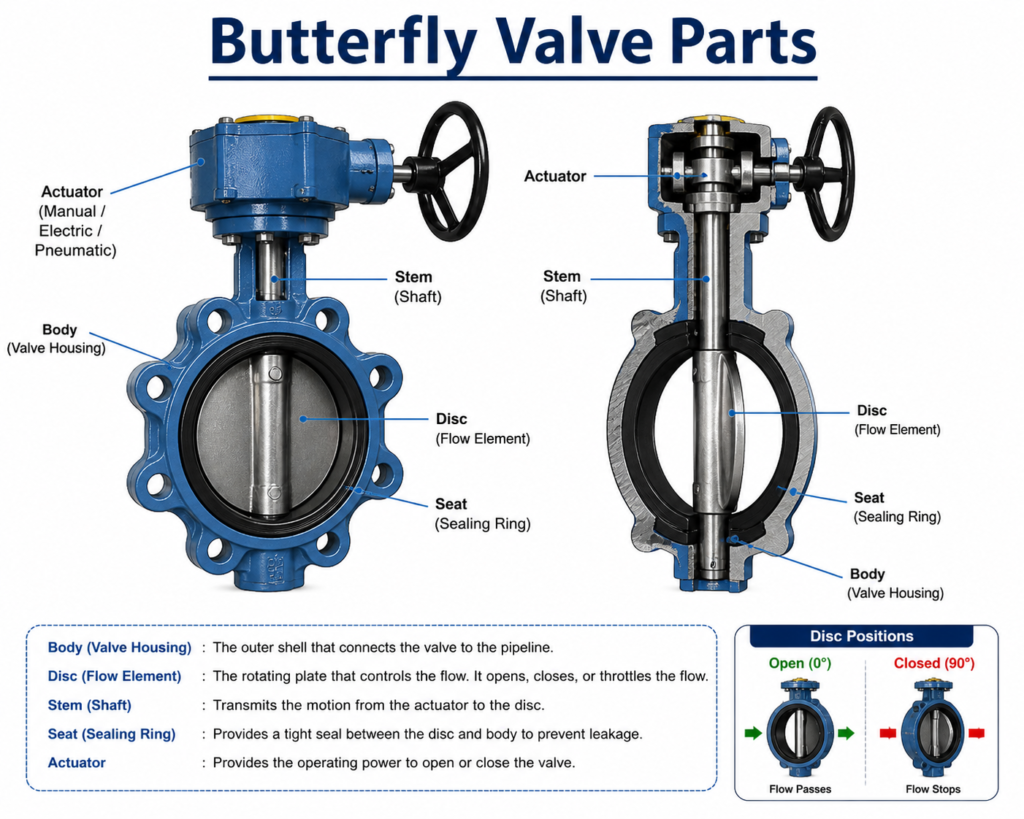
Understanding the butterfly valve parts helps you troubleshoot problems faster. Here is what each part does:
1. Body The outer shell of the valve. It connects to the pipeline. Bodies are made from cast iron, ductile iron, stainless steel, carbon steel, or PVC depending on the application.
2. Disc This is the heart of the valve. It is a flat, circular plate that sits in the middle of the pipe. When you rotate the stem, the disc turns. At 0 degrees, the disc is parallel to the flow (fully open). At 90 degrees, it is perpendicular (fully closed).
3. Stem Also called the shaft. It connects the disc to the actuator or handle. When you turn the stem, the disc rotates. The stem must be well-sealed to prevent fluid leakage to the outside.
4. Seat The seat is a ring inside the valve body that the disc presses against when closed. It creates a tight seal. Common seat materials are EPDM, NBR (nitrile rubber), PTFE, and silicone. The choice of seat material depends on the fluid type and temperature.
5. Actuator This is the device that operates the valve. It can be:
- A manual handwheel or lever
- A pneumatic actuator (air-operated)
- An electric actuator (motor-driven)
- A hydraulic actuator (fluid-powered)
In large automated plants, electric or pneumatic actuators are most common because they allow remote control.
📘 Suggested Course: Valves – Principles, Operation & Design
👉 If you want to clearly understand different valve types, working principles, and real-world industrial applications, this course is highly recommended.
👉 Learn valve design and operation in detail: [https://trk.udemy.com/JkmRe7]
How Industrial Butterfly Valves Work (Step-by-Step):
The butterfly valve working principle is simple, which is why it is so popular.
- Step 1: Closed Position: The disc sits perpendicular (at 90°) to the pipeline. It presses against the seat ring, blocking flow completely.
- Step 2: Opening the Valve: The actuator or handle rotates the stem. The stem turns the disc. As the disc rotates from 90° toward 0°, fluid begins to pass through on either side of the disc.
- Step 3: Fully Open Position: At 0° (disc parallel to the pipe axis), resistance is minimal and flow is at its maximum. The disc is still inside the pipe but causes little obstruction.
- Step 4: Throttling / Flow Control: By stopping the disc at any angle between 0° and 90°, you can partially restrict flow. This is called throttling. It is useful in HVAC systems and process lines where you need to control flow rate rather than just open/close.
- Step 5: Closing Again: Rotate the stem back to 90°. The disc seats against the sealing ring. Flow stops.
That’s the entire industrial valve working process — a quarter turn, done.
Types of Industrial Butterfly Valves:
There are four main butterfly valve types you will encounter in the field. Each is designed for different pressure and installation requirements.
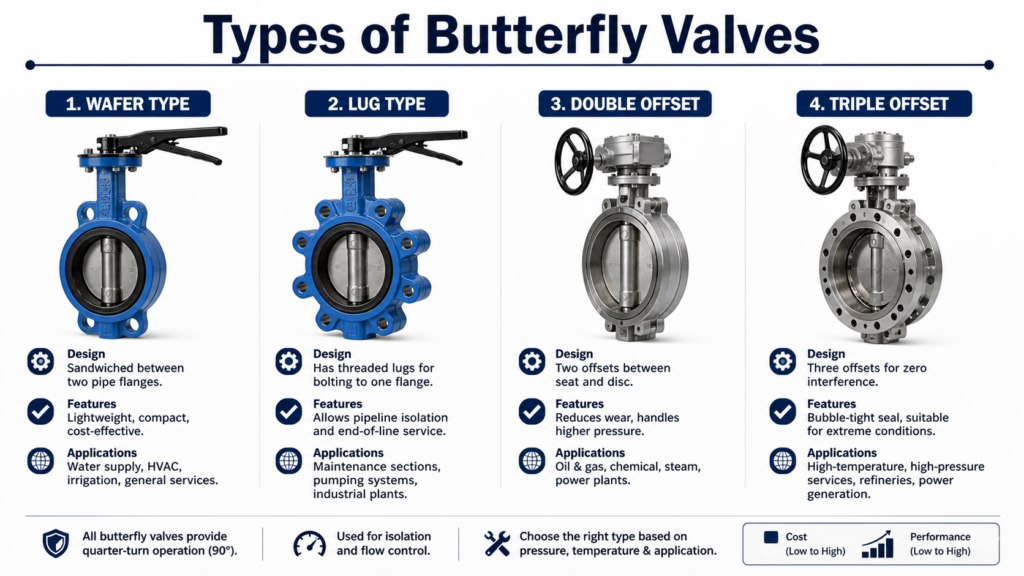
1. Wafer Type:
- The most common and affordable type
- Designed to sit between two pipe flanges using bolts that run through the pipeline flanges
- Compact and lightweight
- Best for: Low to medium pressure systems — water supply, HVAC, general industrial use
- Cannot be used at the end of a pipeline (no blind flange option)
2. Lug Type:
- Has threaded inserts (lugs) around the body
- Can be bolted to a single flange from one side
- Allows you to remove one side of piping without disturbing the other — this is called “dead-end service”
- Best for: Systems where maintenance requires isolating sections of pipe
3. Double Offset (High Performance):
- The stem is offset from the center of the disc — twice
- This causes the disc to “cam away” from the seat when opening, reducing wear
- Handles higher pressures than wafer or lug types
- Best for: Oil & gas, chemical plants, steam lines
4. Triple Offset:
- The stem has three geometric offsets
- When the disc closes, it contacts the seat at the very last moment (metal-to-metal seal)
- Zero leakage — suitable for critical isolation
- Best for: High-temperature, high-pressure applications like refineries and power plants
- Often called a “fire-safe” valve because it can maintain a seal even when elastomers burn away
📘 Suggested Course: Control Valves – Fundamentals, Sizing & Application
👉 Understanding control valve sizing, selection, and real-world applications is essential for efficient process control in industries.
👉 Learn how to choose, size, and troubleshoot control valves effectively: [https://trk.udemy.com/4aWg6r]
Technical Details: Pressure, Temperature, Materials & Sizes:
This section matters a lot for selecting the right valve. Here are the real numbers you need to know.
Pressure Ratings:
| Rating | What It Means |
|---|---|
| PN10 | Max pressure = 10 bar (~145 PSI) |
| PN16 | Max pressure = 16 bar (~232 PSI) |
| Class 150 | Max pressure ≈ 19.6 bar at room temperature (ANSI standard) |
| Class 300 | Max pressure ≈ 51 bar at room temperature |
Most standard wafer butterfly valves are rated PN10 or PN16. Triple offset valves are available in Class 300 and above.
Temperature Range:
- Standard elastomer seat (EPDM/NBR): -10°C to +120°C
- PTFE seat: -20°C to +150°C
- Metal seat (triple offset): -20°C to +600°C
- General operational range for most industrial butterfly valves: -20°C to 200°C
Body Materials:
| Material | Common Abbreviation | Where Used |
|---|---|---|
| Cast Iron | CI | Water systems, HVAC |
| Ductile Iron | DI | Higher strength water/sewage |
| Stainless Steel | SS (304, 316) | Chemical, food, marine |
| Carbon Steel | CS | Oil & gas, high pressure |
| PVC / CPVC | — | Corrosive chemicals, low pressure |
| Bronze | — | Small sizes, potable water |
Valve Sizes:
Industrial butterfly valves are available from 2 inches (50mm) up to 72 inches (1800mm) in diameter.
- Small sizes (2″–6″): Common in HVAC, building services
- Medium sizes (8″–24″): Water treatment, process plants
- Large sizes (30″–72″): Water mains, dams, power stations
Butterfly valve size chart tip: Always match the valve bore to the internal pipe diameter, not the outer diameter. Mismatching causes turbulence and premature seat wear.
Butterfly valve bolt chart tip: For wafer and lug types, use the correct flange standard (ANSI B16.5, DIN, or BS). The bolt circle diameter and number of holes must match your flanges. Always check the manufacturer’s bolt chart before installation.
📘 Suggested Course: Mastering Pump Fundamentals: Design, Selection & Operation
👉 If you want to clearly understand pump design, selection, and real-world operation used in industries, this course is highly recommended.
👉 Learn practical pump engineering concepts here: [https://trk.udemy.com/k4oJL3]
Butterfly Valve Applications:
A). HVAC (Heating, Ventilation, Air Conditioning):
- In large commercial buildings, butterfly valves control chilled water and hot water flow in air handling units. They are preferred here because of their compact size and low pressure drop.
B). Water Treatment Plants:
- These valves are heavily used in raw water intake lines, filter backwash systems, and chemical dosing lines. Cast iron or ductile iron bodies with EPDM seats are standard here.
C). Oil & Gas Industry:
- In refineries and upstream facilities, double offset and triple offset butterfly valves handle crude oil, gas, and steam lines. High-performance versions with metal seats handle temperatures above 300°C.
D). Chemical Industry:
- Stainless steel bodies with PTFE-lined seats handle aggressive acids, solvents, and alkalis. The full-bore design of butterfly valves makes them easy to clean and reduces buildup of chemicals.
E). Food & Beverage:
- Sanitary butterfly valves made from 316L stainless steel with FDA-approved seats are used in breweries, dairies, and pharmaceutical plants.
Advantages of Industrial Butterfly Valves:
- Quick operation: 90° turn opens or closes the valve fully
- Compact and lightweight: takes up much less space than gate valves
- Low cost: especially in larger sizes
- Low pressure drop: the disc causes less resistance than a gate valve
- Good for throttling: unlike gate valves, they can be used for flow control
- Easy to automate: simple to attach pneumatic or electric actuators
- Wide size range: from 2″ to 72″
📘 Suggested Course: Flow of Fluids through Piping Systems, Valves and Pumps
👉 If you want to clearly understand how fluids behave inside pipelines, valves, and pumps in real industrial systems, this course is highly recommended.
👉 Learn practical fluid flow concepts here: [https://trk.udemy.com/AgERLx]
Common Problems and Industrial Valve Maintenance:
This is where field experience matters. Here are the problems I have seen repeatedly — and how to deal with them.
Problem 1: Leakage Through the Seat:
Cause: Worn or damaged seat ring. Can also happen if the disc closes at the wrong angle.
Fix: Inspect the seat for cuts, cracks, or deformation. Replace the seat if damaged. Check the actuator stop settings — the disc may not be fully closing.
Problem 2: Corrosion on the Body or Stem:
Cause: Wrong material selection, or protective coating has broken down.
Fix: In water treatment plants, we see cast iron bodies corroding when the pH drops below 6. Upgrade to ductile iron or line the body with epoxy. Grease the stem periodically with compatible grease.
Problem 3: Hard to Operate (Stiff Handle or Actuator):
Cause: Corrosion on the stem, over-tightening of the gland packing, or swollen seat.
Fix: Lubricate the stem. Check gland packing torque. If the seat is swollen (common with EPDM in hot oil), switch to PTFE or a high-temp seat material.
Problem 4: Vibration and Chattering During Throttling:
Cause: The disc is operating near a partially open position where flow creates turbulence.
Fix: Avoid throttling between 10°–20° or 70°–80° open — these angles create unstable flow. Throttle in the 40°–60° range for stability.
Maintenance Checklist (Every 6 Months):
- Check for external leaks at the stem
- Inspect seat for cracks or wear (use a flashlight)
- Operate the valve through its full range — feel for stiffness
- Lubricate stem and actuator linkage
- Check actuator air supply pressure (for pneumatic types)
- Verify the position indicator matches actual disc position
- Check bolt torque on flanges — re-torque if needed
- Inspect body coating for rust or damage
- Test the end-of-travel stops on the actuator
📘 Suggested Course: Oil & Gas Engineering – Piping, Vessels, Hydrogen & Control
👉 If you want to understand piping systems, pressure vessels, hydrogen systems, and industrial control concepts with real-world engineering applications, this course is highly recommended.
👉 Learn complete oil & gas engineering fundamentals here: [https://trk.udemy.com/6kgVBV]
Butterfly Valve vs Gate Valve:
A common question in the field: should I use a butterfly valve or a gate valve?
Here is a straightforward comparison:
| Feature | Butterfly Valve | Gate Valve |
|---|---|---|
| Operation | 90° quarter turn | Multi-turn (many rotations) |
| Speed | Fast (seconds) | Slow (minutes) |
| Size/Weight | Compact and light | Bulky and heavy |
| Cost (large sizes) | Much cheaper | Expensive |
| Pressure drop when open | Low | Very low (full bore) |
| Throttling ability | Yes (moderate) | Poor — not recommended |
| Tight shutoff | Good (with soft seat) | Excellent |
| Maintenance | Easier | More complex |
| Best for | Flow control, isolation | Full isolation, high pressure |
My take from field experience: For water and HVAC systems above 8″, butterfly valves almost always make more sense economically and practically. For high-pressure steam or situations needing zero leakage at very high pressures, gate valves are still the better choice.
Conclusion:
Industrial butterfly valves are reliable, simple, and versatile. They handle everything from cooling water in a building to crude oil in a refinery. Understanding how they work — the disc, seat, stem, and actuator — helps you select the right valve, install it correctly, and maintain it before small problems become big shutdowns.
Whether you are specifying a new system or troubleshooting an existing one, knowing the basics of industrial butterfly valves gives you a real advantage on the job. Keep your seat materials matched to your fluid, check your pressure ratings, and do regular maintenance — and these valves will give you years of trouble-free service.