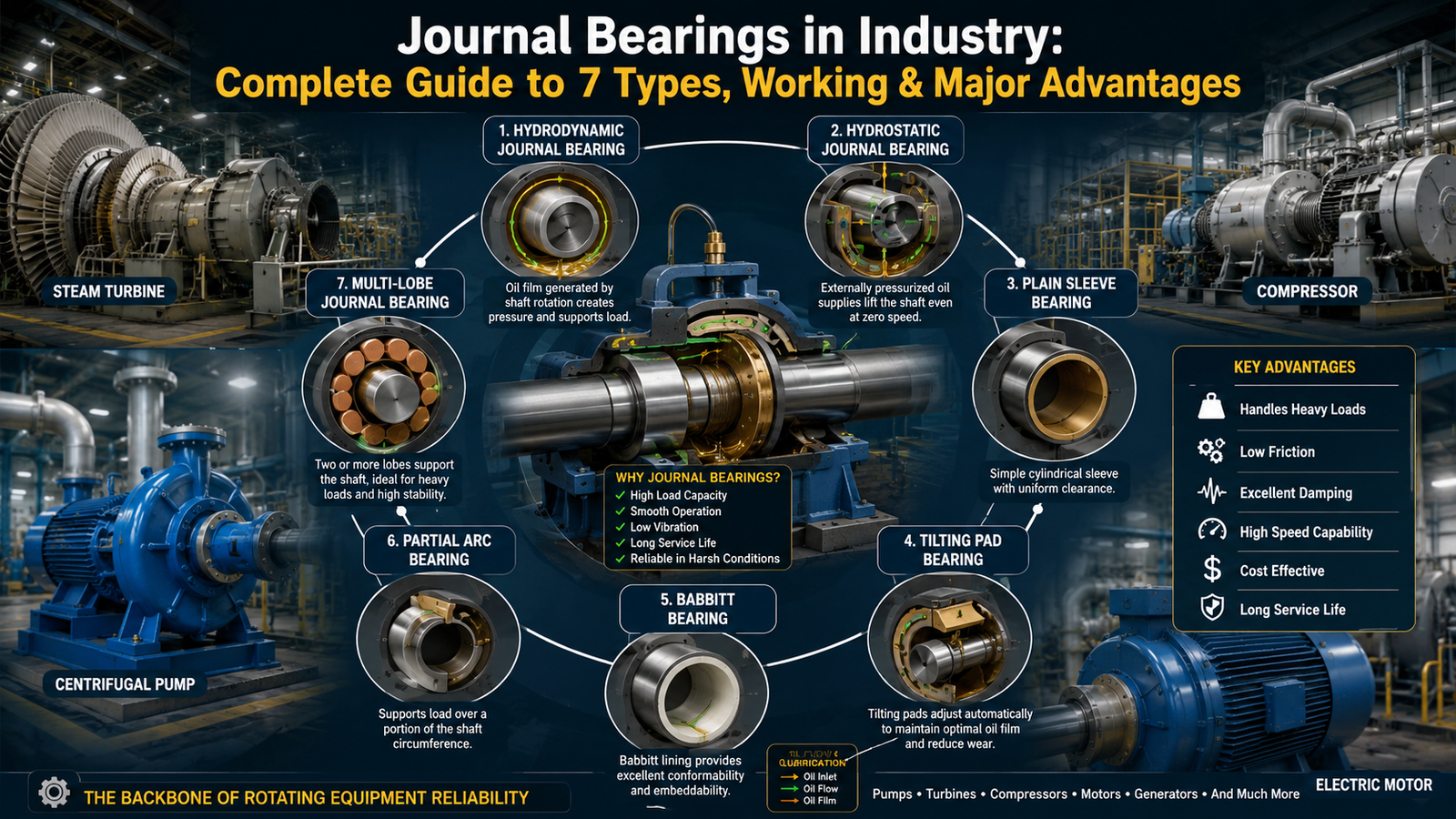
Journal bearings in industry are the unsung workhorses keeping the largest rotating machines running. In steam turbines, centrifugal compressors, large electric motors, and hydroelectric generators, these bearings carry enormous loads while spinning at high speeds — hour after hour, year after year. Without a functioning journal bearing, a 50 MW turbine doesn’t run at reduced efficiency. It stops.
This guide covers the seven main types used across industrial facilities, explains how they work from a maintenance perspective, and outlines the real-world advantages and failure modes every maintenance engineer should know.
📘 Suggested Course: Bearing Course – From Zero to Failure Analysis
👉 If you want to understand bearing fundamentals, bearing types, installation practices, and failure analysis techniques with real-world industrial applications, this course is highly recommended.
👉 Learn complete bearing engineering fundamentals here: [https://trk.udemy.com/vDjj5A]
👉 Get full subscription access: https://trk.udemy.com/PzKGrq
What Are Journal Bearings in Industry?
A journal bearing supports a rotating shaft — called the journal — inside a stationary cylindrical housing. The shaft rides on a thin film of pressurized lubricant rather than on rolling elements. That’s the fundamental difference from ball or roller bearings, and it’s what makes them capable of handling loads that would destroy a rolling-element bearing within hours.
The term ‘journal’ refers specifically to the portion of the shaft that runs inside the bearing. Industrial journal bearings are typically made from babbitt metal (a soft white metal alloy), bronze, or polymer composite lined materials, selected based on load, speed, and operating temperature.
In a plant setting, you find journal bearings wherever the load is continuous and high, the speed is elevated, and reliability is non-negotiable. Anything less and you’re looking at unplanned downtime that costs far more than the bearing itself.
How Journal Bearings Work in Industrial Machines:
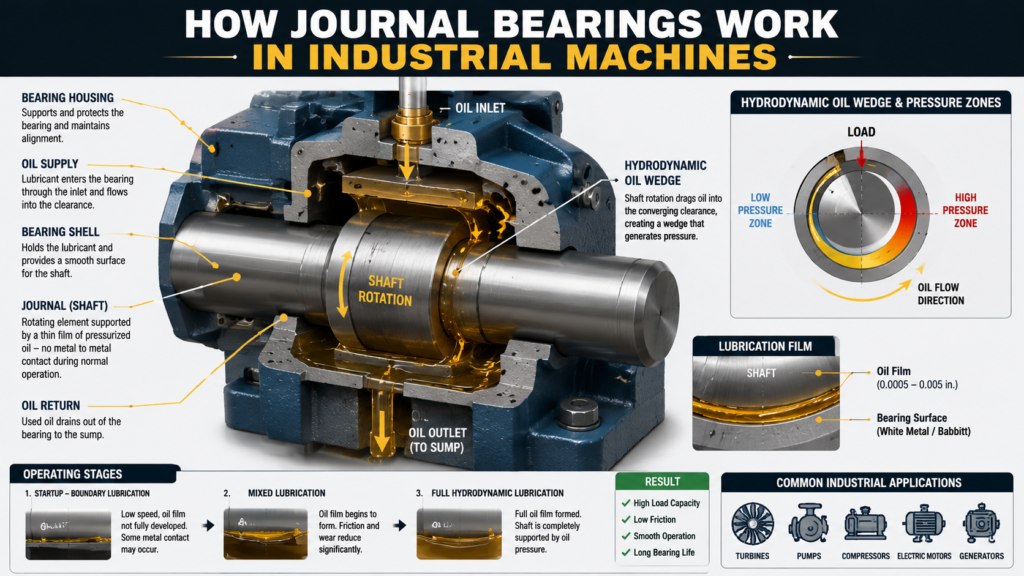
The operating principle is hydrodynamic lubrication. When the shaft starts rotating, it drags oil into the small clearance gap between the journal surface and the bearing bore. As speed increases, this dragging action builds oil pressure that lifts the shaft off the bearing surface. The shaft rides on the oil film — not on metal.
This pressurized wedge of oil is called the hydrodynamic oil wedge. Its thickness depends on oil viscosity, shaft speed, bearing geometry, and applied load. A typical film thickness in an industrial turbine bearing ranges from 0.0005 to 0.005 inches. Small number — huge consequence if lost.
Key Stages of Operation:
- Boundary lubrication at startup: Metal-to-metal contact during low-speed startup is unavoidable. This is when most wear occurs in journal bearings. Proper startup procedures and oil pre-circulation systems exist specifically to minimize this phase.
- Mixed lubrication transition: As speed builds, the film begins forming. Friction and wear drop sharply.
- Full hydrodynamic film: Operating speed is reached. The shaft is fully supported by oil pressure. Friction is at minimum. Bearing temperature stabilizes.
A practical maintenance point: if a machine trips and immediately restarts before the bearing has cooled or the oil film has re-established, that restart is operating through boundary lubrication on a hot surface. Some facilities have learned this lesson the expensive way.
📘 Suggested Course: Machine Design Basics – I – Shaft, Bearings & Gears
👉 If you want to understand shaft design, bearing selection, gear fundamentals, and machine design concepts with real-world engineering applications, this course is highly recommended.
👉 Learn complete machine design fundamentals here: [https://trk.udemy.com/YVnnXO]
👉 Get full subscription access: https://trk.udemy.com/PzKGrq
7 Types of Journal Bearings Used in Industry:
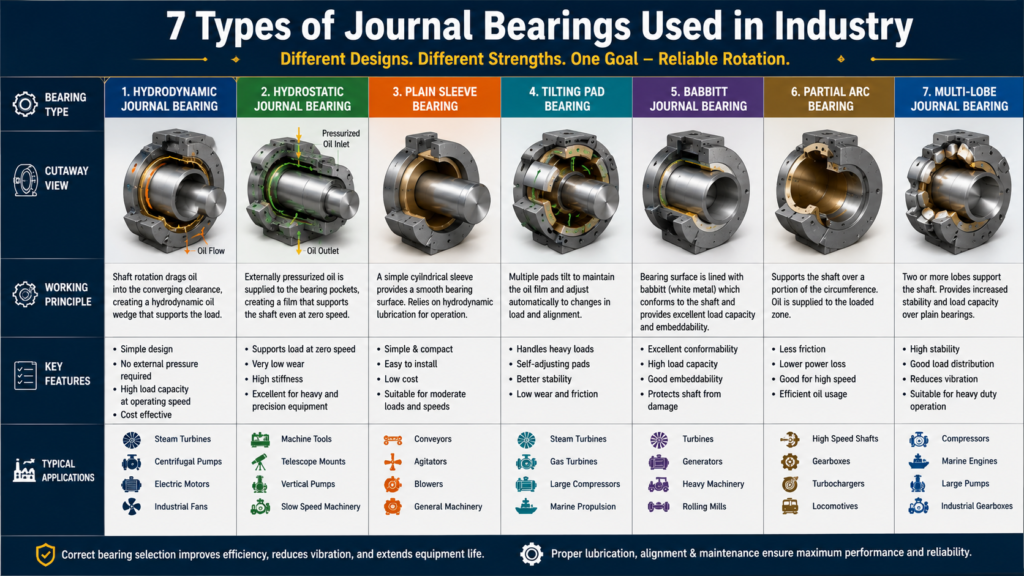
Not all journal bearings are the same. The type selected for a given application determines load capacity, stability characteristics, oil system requirements, and how the bearing responds to varying operating conditions.
1. Hydrodynamic Journal Bearings:
The most common type in heavy industry. Lubrication pressure is generated entirely by the shaft’s rotation — no external pump pressure is required to form the film.
- Working principle: Shaft rotation draws oil into a converging wedge gap. The resulting pressure lifts the shaft and maintains separation from the bearing surface.
- Industrial applications: Steam turbines, centrifugal pumps, large electric motors, industrial fans, gearboxes.
- Advantages: Simple construction, no external pressurization system needed, excellent load capacity at design speed.
- Limitations: Film breaks down at low speeds; startup wear is inherent. Requires consistent oil viscosity and temperature.
- Maintenance observation: Most hydrodynamic bearing failures in the field trace back to either contaminated oil or a lubrication system that didn’t deliver oil fast enough during a restart. Check lube oil supply pressure trending, not just temperature.
2. Hydrostatic Journal Bearings:
Unlike hydrodynamic designs, hydrostatic bearings use an external pressurized oil supply to create and maintain the lubricating film regardless of shaft speed — including at zero RPM.
- Working principle: High-pressure oil is fed into recessed pockets in the bearing bore from an external pump. This pressurized oil supports the shaft directly.
- Industrial applications: Heavy journal grinding machines, large telescope mounts, slow-speed shaft turning gear systems on turbines, vertical pump bearings.
- Advantages: Near-zero wear at all speeds, very high stiffness, excellent damping characteristics, no startup wear phase.
- Limitations: Requires reliable high-pressure external oil system; more complex; if external supply fails, so does the bearing.
- Maintenance observation: The external pump and filtration system are the critical failure points. Maintain cleanliness to ISO 4406 cleanliness codes and check pump delivery pressure frequently.
📘 Suggested Course: Learn All About Rolling Contact Bearings and Its Selection
👉 If you want to understand rolling contact bearing types, working principles, selection methods, and real-world industrial applications, this course is highly recommended.
👉 Learn complete bearing fundamentals and selection techniques here: [https://trk.udemy.com/9Vzz4e]
👉 Get full subscription access: https://trk.udemy.com/PzKGrq
3. Plain Sleeve Bearings:
The simplest form of journal bearing — a cylindrical sleeve of bearing material pressed or shrunk into a housing bore. No elaborate geometry, no special pads, no oil pockets.
- Working principle: Operates on standard hydrodynamic principles. The smooth cylindrical bore forms the bearing surface.
- Industrial applications: Electric motors, small pumps, conveyors, blowers, industrial fans, smaller gearboxes.
- Advantages: Low cost, easy to manufacture, straightforward to replace during maintenance, handles moderate continuous loads.
- Limitations: Less stable than multi-geometry designs at high speeds; susceptible to oil whirl instability above certain speed-to-load ratios.
- Maintenance observation: Measure bore diameter and shaft journal diameter on every planned outage. Clearance growth over time is the reliable indicator of wear rate. Document the numbers; trend them.
4. Tilting Pad Journal Bearings:
These bearings replace the solid cylindrical bore with multiple individual pads that can pivot or tilt around their own pivot points. Each pad generates its own pressure film, and all pads collectively support the shaft.
- Working principle: Each pad tilts automatically to maintain optimum film geometry as load and speed change. This self-adjustment eliminates oil whirl and half-frequency whip instability.
- Industrial applications: High-speed steam and gas turbines, centrifugal compressors, turboexpanders, high-speed generators.
- Advantages: Excellent rotor dynamic stability, highest load capacity among journal bearing types, handles both radial loads and rotor instability effectively.
- Limitations: Higher manufacturing cost; more components to inspect and reassemble; requires precise alignment of pads during assembly.
- Maintenance observation: Pad wear is not uniform. Always measure each pad individually during overhaul. One worn pad throws the load distribution off on all others. Inspect pivot surfaces for Brinelling or fretting wear.
5. Babbitt Journal Bearings:
Babbitt refers to the lining material, not the bearing geometry. Babbitt is a soft white metal alloy — tin-based or lead-based — bonded to a steel or bronze backing shell. The term is used broadly in the industry to describe any journal bearing with a babbitt-lined surface.
- Working principle: The soft babbitt surface conforms to minor shaft irregularities and embeds abrasive particles rather than allowing them to scratch the journal. This sacrificial quality protects the shaft.
- Industrial applications: Steam turbines, large reciprocating compressors, industrial generators, heavy rolling mill equipment, marine propulsion shafts.
- Advantages: Excellent conformability, good embeddability for contaminants, easy to re-pour or re-line during major overhauls, forgiving of minor shaft imperfections.
- Limitations: Fatigue strength is limited at high temperatures; babbitt softens above 300°F and loses load capacity. Not suitable for very high-temperature applications without cooling.
- Maintenance observation: Babbitt fatigue shows as cracking and flaking, typically starting at areas of maximum loading. When re-lining babbitt in the field, bonding preparation is everything — poor bonding causes delamination under load.
📘 Suggested Course: Advanced Diploma in Mechanical Engineering
👉 If you want to strengthen your understanding of mechanical engineering fundamentals, design concepts, and industrial applications with practical knowledge, this course is highly recommended.
👉 Learn complete mechanical engineering concepts here: [https://trk.udemy.com/k4MMDM]
👉 Get full subscription access: https://trk.udemy.com/PzKGrq
6. Partial Arc (Partial Journal) Bearings:
Instead of wrapping 360 degrees around the shaft, partial arc bearings provide a bearing surface over only a portion of the shaft circumference — typically 60 to 180 degrees.
- Working principle: The partial arc generates a hydrodynamic film over the loaded arc section. The open section allows for easier oil circulation and heat removal.
- Industrial applications: Lightly loaded shafts, some steam turbine designs, horizontal shaft applications where gravity loading is well-defined and unidirectional.
- Advantages: Reduced friction in lightly loaded conditions, better oil flow and cooling, simpler housing geometry.
- Limitations: Load direction must be predictable; not suitable where load reversal can occur. Limited to specific application geometries.
- Maintenance observation: Confirm load direction assumptions haven’t changed due to process modifications or piping changes before reinstalling a partial arc design. Load direction changes can cause rapid failure.
7. Multi-Lobe Journal Bearings:
Multi-lobe bearings have a bore profile with two, three, or four distinct lobes rather than a smooth cylinder. Each lobe creates a separate converging film region, giving the shaft multiple points of hydrodynamic support.
- Working principle: The lobed bore geometry creates a pre-loaded condition on the shaft. Multiple simultaneous pressure wedges prevent the rotor instability that can occur in plain cylindrical designs.
- Industrial applications: High-speed blowers, turbochargers, process compressors, some steam turbines where speed-to-load ratio creates instability risk.
- Advantages: Good stability over a wide speed range, reduces oil whirl tendency, handles moderate loads with good damping.
- Limitations: Higher power loss than plain cylindrical bearings due to pre-load friction; requires precise manufacturing to maintain lobe geometry.
- Maintenance observation: Multi-lobe bearings are sensitive to clearance — both too tight and too loose cause problems. Measure and record clearances at every outage, and compare to OEM specifications rather than general industry tables.
📘 Suggested Course: Learn the Fundamentals of Mechanical Engineering
👉 If you want to understand core mechanical engineering concepts, engineering principles, and essential topics with real-world applications, this course is highly recommended.
👉 Learn complete mechanical engineering fundamentals here: [https://trk.udemy.com/xJ55VO]
👉 Get full subscription access: https://trk.udemy.com/PzKGrq
Major Advantages of Journal Bearings in Industry:
The table below summarizes why journal bearings remain the preferred choice in critical rotating equipment across heavy industry.
| Advantage | Industrial Benefit |
| High Load Capacity | Handles heavy radial and axial loads in turbines, compressors, and large motors without premature failure |
| Shock Absorption | The hydrodynamic oil film absorbs impact loads — critical in rolling mills, crushers, and reciprocating machinery |
| Lower Vibration | Fluid film damping reduces vibration amplitude in high-speed rotating equipment, protecting adjacent components |
| Long Service Life | When properly lubricated and maintained, service intervals exceed 100,000 operating hours in turbines |
| Low Maintenance Cost | No rolling elements to replace; maintenance cost per year is significantly lower than rolling-element bearings in comparable applications |
| Quiet Operation | Fluid film eliminates metal-to-metal contact noise — ideal for applications near sensitive instrumentation or occupied areas |
| Better High-Speed Performance | No DN limit issues from rolling-element fatigue; suitable for turbines running 3,600 RPM and above continuously |
Common Journal Bearing Failure Problems:
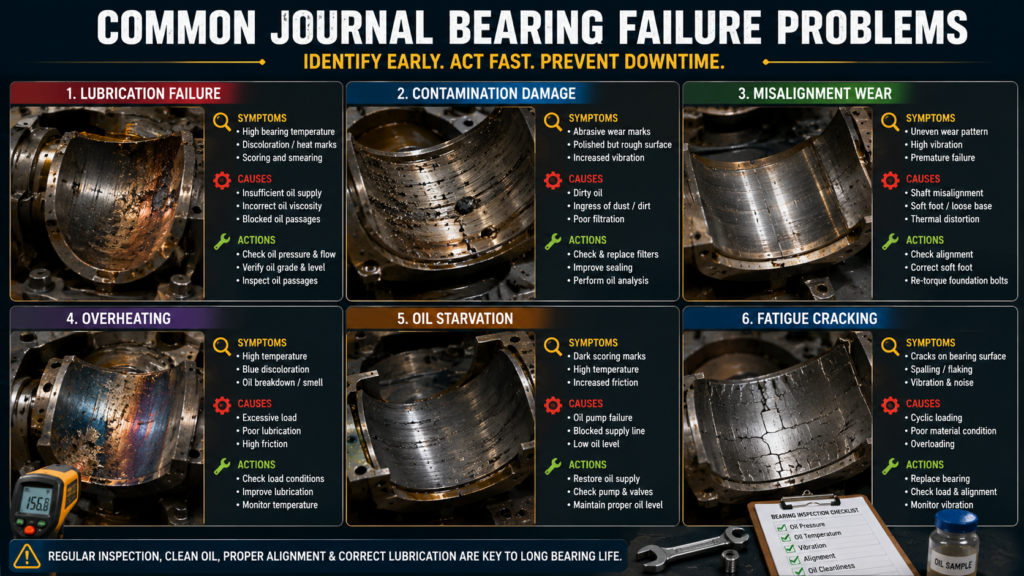
Most journal bearing failures are not random. They have identifiable causes, and in most cases, there were warning signs well before the failure became catastrophic. The table below covers the most common failure modes seen in industrial plants.
| Failure Mode | Symptoms | Possible Causes | Recommended Actions |
| Lubrication Failure | Rising bearing temperature; metal-in-oil; increased vibration | Low oil flow, degraded oil, wrong viscosity | Check lube system, sample oil, inspect filters |
| Contamination | Scoring marks on journal; abrasive wear; silt in oil samples | Dirty oil, failed seals, poor filtration | Pull oil sample, inspect filters, check seals |
| Misalignment | Uneven wear pattern on bearing surface; high shaft runout | Thermal expansion, improper coupling alignment | Laser align shaft; check for soft foot |
| Excessive Temperature | Bearing temp > normal range; discolored babbitt | Insufficient oil flow, high ambient temp, overload | Check coolers, oil flow rate, verify load conditions |
| Oil Starvation | Immediate temperature spike; scoring; seizure risk | Pump failure, clogged line, low reservoir level | Inspect lube pump; check suction; verify level alarm |
| Bearing Wear | Increased clearance; shaft drop; vibration shift | Long service, abrasion, fatigue | Measure clearances; replace when beyond tolerance |
| Fatigue Damage | Cracking or flaking of babbitt surface | Cyclic overloading, misalignment, vibration | Replace bearing shell; root-cause load analysis |
A note on oil analysis as a diagnostic tool: regular oil sampling provides early warning for contamination and wear metal buildup months before vibration or temperature changes are detectable. In facilities running predictive maintenance programs, oil analysis is a standard practice — not an optional one. Elevated iron or tin content in a turbine oil sample is a bearing wear signal that demands follow-up.
📘 Suggested Course: Basics of Electric Motor for Mechanical Engineers
👉 If you want to understand electric motor fundamentals, working principles, motor types, and their real-world industrial applications, this course is highly recommended.
👉 Learn complete electric motor fundamentals here: [https://trk.udemy.com/5kZZ2D]
👉 Get full subscription access: https://trk.udemy.com/PzKGrq
Industrial Applications of Journal Bearings:
Journal bearings appear across virtually every heavy industry sector. The applications below represent the most common and highest-consequence uses.
1). Steam Turbines:
- Multi-stage steam turbines in power generation and petrochemical facilities almost universally use tilting pad or plain hydrodynamic journal bearings for rotor support. Bearing condition directly determines turbine availability. A forced turbine outage due to bearing failure at a 500 MW power plant costs far more per hour than any bearing program investment.
2). Gas Turbines:
- Industrial gas turbines in pipeline compression and power generation use journal bearings at both the compressor and turbine ends of the rotor. Tilting pad designs are common here due to the wide speed range and rotor dynamic requirements. Bearing clearance and oil supply temperature are closely monitored parameters.
3). Centrifugal Pumps:
- Large centrifugal pumps in refineries, chemical plants, and water treatment facilities use journal bearings in the bearing frames. For high-speed, high-flow pumps, hydrodynamic journal bearings provide the load capacity and stability that rolling-element designs cannot match at equivalent DN values.
4).Compressors:
- Both centrifugal and reciprocating compressors use journal bearings extensively. Centrifugal compressors in air separation, refrigeration, and gas processing applications run tilting pad bearings. Reciprocating compressors use babbitt-lined sleeve bearings at the crankshaft main bearings and crosshead pins.
5). Electric Motors and Generators:
- Large synchronous generators and high-voltage motors above a certain power threshold use journal bearings rather than rolling-element designs. The continuous duty cycle, high loads, and required service life make hydrodynamic bearings the standard for this equipment class.
6). Paper Mills:
- Paper machine rolls run journal bearings in flooded or circulated oil housings. The load from nip pressure on large rolls, combined with continuous 24/7 operation, demands the load capacity and long service life of journal bearing designs. Roll speed, paper grade, and nip load all influence bearing selection and lubrication requirements.
7). Mining Equipment:
- Cone crushers, gyratory crushers, and large mill trunnion bearings in mining operations use journal bearings to handle the severe shock loads and contamination conditions. Babbitt-lined journal bearings in crusher mainframe bearings are routinely re-poured in the field as part of scheduled major overhauls.
8). Manufacturing Systems:
- Rolling mill drive systems, large press machinery, and continuous casting equipment in steel manufacturing use journal bearings at key shaft positions. Equipment reliability in these applications directly impacts production throughput — bearing failures translate to costly production interruptions.
📘 Suggested Course: Automotive Engineering Diploma
👉 If you want to understand automotive systems, vehicle components, engine technologies, and modern automotive engineering concepts with real-world applications, this course is highly recommended.
👉 Learn complete automotive engineering fundamentals here: [https://trk.udemy.com/Ag33xD]
👉 Get full subscription access: https://trk.udemy.com/PzKGrq
Frequently Asked Questions:
1. What is the main advantage of journal bearings over rolling-element bearings in industrial equipment?
- The primary advantage is their ability to carry very high continuous radial loads at high rotational speeds without fatigue failure. The hydrodynamic oil film provides exceptional load capacity, vibration damping, and long service life compared to ball or roller bearings in the same application. In heavy, continuous-duty equipment like steam turbines and large compressors, journal bearings are the standard choice because rolling-element bearings simply cannot match the required load and speed combination over a practical service interval.
2. How often should industrial journal bearings be replaced?
- There is no fixed interval. Journal bearings, when properly lubricated and maintained, can operate for 100,000 hours or more without replacement. Replacement should be based on measured clearance growth, visual inspection during planned outages, and condition monitoring data — not calendar time. Plants using oil analysis, vibration trending, and clearance documentation make replacement decisions on equipment condition, not arbitrary schedules.
3. What causes journal bearing failure in industrial machinery?
- The most common causes in order of field frequency are: lubrication failure (insufficient flow, degraded oil, wrong viscosity), contamination (particles or water in the oil), misalignment (both static and dynamic thermal), and overloading (operating beyond design conditions). Fatigue damage from cyclic overloads and oil starvation during startup are also significant contributors. Most of these causes are preventable with proper lubrication systems, oil analysis programs, and routine alignment checks.
4. What is the difference between hydrodynamic and hydrostatic journal bearings?
- A hydrodynamic journal bearing generates its lubricating film from shaft rotation — no external pressure source is needed during operation. A hydrostatic journal bearing uses an external high-pressure oil pump to supply pressurized oil to recessed pockets in the bearing, creating the supporting film regardless of shaft speed. Hydrostatic designs can support the shaft at zero speed and provide much higher stiffness, but they require a reliable external oil pressure system. Hydrodynamic designs are simpler and more common; hydrostatic designs are used where startup wear must be eliminated or where very high stiffness is required.
5. What oil viscosity is correct for an industrial journal bearing?
- Correct viscosity depends on bearing clearance, shaft diameter, operating speed, and bearing temperature. The OEM specification is the baseline. As a practical rule, most industrial journal bearings in turbines and compressors use ISO VG 32 or VG 46 turbine oil. Heavier machinery like large reciprocating compressors may use VG 68 or VG 100. Do not change viscosity grade without confirming with the OEM or performing a bearing film thickness calculation — running too light a viscosity reduces film thickness and accelerates wear; too heavy increases operating temperature and startup torque.
6. Can journal bearings handle thrust loads?
- Standard radial journal bearings are designed for radial loads — loads perpendicular to the shaft axis. They do not handle axial (thrust) loads. In machinery where both radial and thrust loads exist, a separate thrust bearing is used in combination with the journal bearing. Some designs integrate a thrust collar and face into the journal bearing housing, but the two functions are typically separate elements designed and monitored independently.
7. How does alignment affect journal bearing life in rotating equipment?
- Misalignment is one of the most damaging conditions for journal bearings. Both angular and offset misalignment concentrate load on one edge of the bearing surface rather than distributing it evenly. This causes uneven babbitt wear, elevated operating temperature, and significantly shortened bearing life. In coupled machinery, hot alignment checks at operating temperature are more meaningful than cold checks. Soft foot, piping strain, and thermal growth all contribute to misalignment — treating them as separate problems rather than part of the same alignment picture leads to persistent bearing failures.
Conclusion:
Journal bearings in industry have been keeping critical rotating equipment running for well over a century, and the underlying physics that makes them effective hasn’t changed. A well-maintained hydrodynamic film between a rotating shaft and its bearing surface is still the most reliable way to support high loads at speed.
The seven types covered here — hydrodynamic, hydrostatic, plain sleeve, tilting pad, babbitt, partial arc, and multi-lobe — each occupy a specific role in industrial machinery. Selecting the right type for the application, building a proper lubrication system around it, and maintaining that system with consistent oil analysis, temperature monitoring, and vibration trending are what separate plants that get decades of reliable service from their rotating equipment versus those that chase reactive bearing failures.
Industrial bearing applications demand more than installation knowledge. They demand ongoing attention to oil condition, clearances, alignment, and operating parameters. The maintenance engineer who understands journal bearing behavior — not just bearing identification — is the one who keeps critical machinery running.