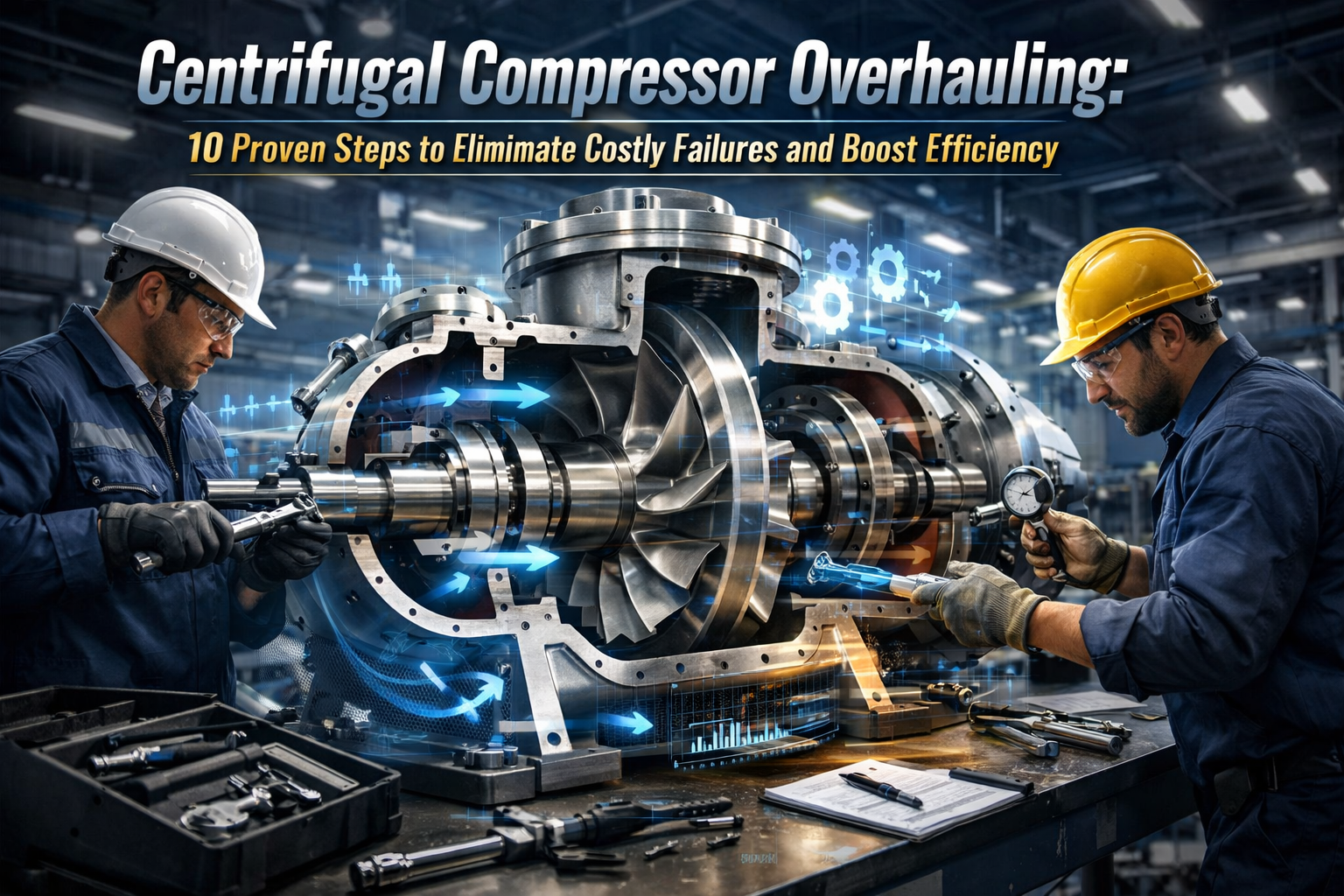
If you manage or maintain a centrifugal compressor, you already know one thing: when it goes down, everything stops.
Production halts. Repair costs pile up. And everyone is standing around waiting. That is the reality in refineries, chemical plants, power stations, and HVAC systems across the country.
The good news? Most centrifugal compressor failures are preventable. A proper, planned overhaul can dramatically extend equipment life, improve centrifugal compressor efficiency, and cut operating costs — sometimes by 20 to 30 percent.
This guide walks you through a proven, 10-step overhaul process that works whether you are doing your first compressor teardown.
If you want to deeply understand compressors, pumps, and other rotating equipment with real-world industrial examples, this course is highly recommended.
👉 Learn practical maintenance techniques of rotating equipment here: [If you want to deeply understand compressors, pumps, and other rotating equipment with real-world industrial examples, this course is highly recommended.
👉 Learn practical Rotating equipment masterclass here: [trk.udemy.com/enqb2r]
What Is a Centrifugal Compressor and Why Does It Need an Overhaul?
A centrifugal compressor is a type of dynamic compressor. It uses a high-speed rotating impeller to accelerate gas and then convert that speed into pressure. Think of it like a fan — but instead of moving air slowly at low pressure, it pushes gas at very high speed and compresses it.
These machines run in some of the harshest environments imaginable: high temperatures, corrosive gases, continuous 24/7 operation. Over time, components wear down. Seals degrade. Bearings fatigue. Impellers develop micro-cracks or corrosion.
An overhaul is a planned, deep-level inspection and restoration of the compressor to its original — or better — performance condition. It is not just a quick fix. It is a full teardown, inspection, repair or replacement, and reassembly.
Skipping overhauls does not save money. It just delays bigger, more expensive failures.
How a Centrifugal Compressor Works (Quick Overview):
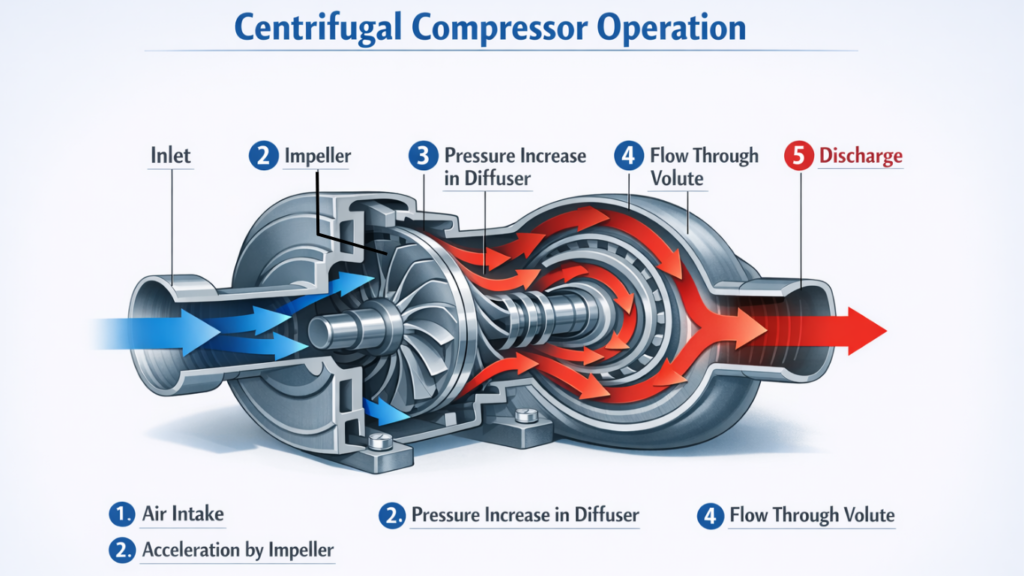
Before you tear anything apart, it helps to understand what you are working with. Gas enters through the inlet. The impeller — spinning at 10,000 to 30,000 RPM — grabs the gas and throws it outward using centrifugal force. The gas enters a diffuser, where speed drops and pressure rises. It then moves to the next stage (in multi-stage compressors) or exits through the discharge.
Key components include the shaft, impeller(s), diffuser, casing, bearings (journal and thrust), seals, and coupling. Each of these is inspected and evaluated during an overhaul.
📘 Suggested Course: Centrifugal Compressors – Principles, Operation and Design
👉 If you want to clearly understand compressor working principles, design concepts, and real industrial applications, this course is highly recommended.
👉 Learn step-by-step from fundamentals to advanced concepts: [https://trk.udemy.com/QYJVDa]
10-Step Centrifugal Compressor Overhaul Process:
Step 1: Pre-Overhaul Planning and Documentation:
The overhaul starts before you touch a single bolt. Gather the Original Equipment Manufacturer (OEM) manuals, historical maintenance records, and the last inspection report. Review operating data — vibration trends, temperature logs, power consumption — to understand where problems may be hiding.
Create a detailed work scope. List every component that needs inspection, testing, or replacement. Order long-lead spare parts early — seal kits, bearings, and custom impellers can take weeks to arrive.
Step 2: Safe Isolation and Shutdown:
Safety first — always. Follow your site’s lockout/tagout (LOTO) procedures. Depressurize the system completely. Purge any hazardous or flammable gas from the casing. Verify with gas detection equipment that the area is safe before opening any flanges.
One common issue I have seen on job sites is teams rushing this step to save time. That is dangerous. A pressurized compressor casing is not something to gamble with.
Step 3: Condition Assessment Before Teardown:
Before you disassemble anything, take baseline measurements. Record shaft runout, coupling alignment, and casing bolt torque values. Do a visual inspection for leaks, corrosion, or unusual deposits on the inlet filter. Photograph everything.
These baseline numbers tell a story. They show you what caused the problem — not just what the problem is.
📘 Suggested Course: Understand & Predict Your Centrifugal Compressor Performance
👉 Want to accurately predict compressor behavior, efficiency, and performance before problems occur? This course will help you do exactly that.
👉 Start learning here: [https://trk.udemy.com/KBJkM7]
Step 4: Systematic Disassembly:
Disassemble the compressor in the exact sequence recommended by the OEM. Mark every component with its orientation and position. Use a parts tray or labeled bags to avoid losing small components like shims and o-rings.
For multi-stage centrifugal compressors, keep each stage’s parts together. Mixing components from different stages is a common mistake that leads to reassembly errors.
Step 5: Detailed Component Inspection:
This is the most critical step in the overhaul. Every major component gets a thorough inspection:
- Impeller: Check for erosion, corrosion, cracks, and blade damage. Use dye penetrant or magnetic particle testing for micro-cracks.
- Shaft: Measure runout and check for bending. Even a 0.001-inch bow can cause vibration at high RPM.
- Bearings: Look for pitting, scoring, or wiping on journal and thrust bearings. Replace if in doubt.
- Seals (dry gas or labyrinth): Check for wear and leakage. Seal failures are a top cause of unplanned shutdowns.
- Casing: Inspect for cracks, erosion, and gasket surface condition.
Step 6: Precision Repair and Component Restoration:
Once inspection is complete, repair or replace worn components. Balance the impeller to ISO G1.0 or G2.5 standards — imbalance is one of the leading causes of high vibration and bearing failure in centrifugal compressors.
In real-world applications, many facilities also take this opportunity to upgrade to better seal technology or more corrosion-resistant impeller materials. These upgrades pay for themselves quickly through reduced maintenance cost.
📘 Suggested Course: Industrial Compressors Maintenance & Troubleshooting
👉 If you want to understand real-world compressor failures, troubleshooting techniques, and maintenance practices used in industries, this course is highly recommended.
👉 Learn how to diagnose and fix compressor issues effectively: [https://trk.udemy.com/6kA2mQ]
Step 7: Precision Reassembly:
Reassembly is not just reverse disassembly. Use calibrated torque wrenches. Follow OEM torque sequences for casing bolts. Apply proper lubricants or anti-seize compounds where specified. Install new gaskets and o-rings — never reuse old ones.
Check impeller clearances against OEM specifications. Even a small deviation here affects centrifugal compressor efficiency significantly.
Step 8: Shaft Alignment and Coupling Installation:
Precision shaft alignment is non-negotiable. Misalignment — even minor misalignment that you cannot see with the naked eye — causes excessive bearing loads, vibration, and seal wear.
Use laser alignment tools. Target angular and offset values within 0.001 to 0.002 inches, depending on the driver speed. Do a hot check alignment if possible, since thermal growth during operation shifts alignment.
Step 9: Pre-Commissioning Checks and Testing:
Before starting up the compressor, verify:
- Lube oil system is flushed and ready
- Seal gas supply is confirmed and at correct pressure
- Vibration probes and temperature sensors are installed and calibrated
- Pressure relief valves are set and tested
- Control system interlocks are verified
📘 Suggested Course: Reciprocating Compressors – Principles, Operation & Design
👉 If you want to clearly understand reciprocating compressor working, valve mechanisms, design concepts, and real-world industrial applications, this course is highly recommended.
👉 Learn step-by-step with practical insights: [https://trk.udemy.com/9VAvKE]
Step 10: Controlled Startup and Performance Verification:
Start the compressor slowly and monitor closely during the first few hours. Check vibration levels (target below 1 mil peak-to-peak for most machines), bearing temperatures, seal leakoff rates, and lube oil pressure.
Run a performance test — compare actual flow, pressure rise, and power draw to the design curve. If the compressor is performing outside its expected range, investigate before ramping up to full load.
Real-World Experience: What Actually Happens on Site:
I have worked on centrifugal compressor overhauls in petrochemical plants and natural gas processing facilities. Here is what the textbooks do not always tell you.
One common issue I have seen is teams underestimating the time needed for lube oil system flushing. The flush has to remove all particles and contaminants from the piping before the new bearings go in. Rushing this step leads to bearing failures within weeks of restart.
Another real-world challenge is impeller deposits. In natural gas service, hydrocarbon liquids can coat the impeller blades over time. This added weight throws off dynamic balance, causes vibration, and reduces centrifugal compressor efficiency. A thorough cleaning and rebalancing during overhaul fixes this — and the performance improvement is immediately noticeable.
In real-world applications, a properly executed overhaul on an older compressor can recover efficiency losses of 5 to 15 percent. That translates directly into lower energy bills and reduced operating cost.
Types of Overhauls for Centrifugal Compressors:
Not every overhaul is the same. There are three main levels:
- Minor overhaul: Seal replacement, bearing inspection, alignment check. Typically every 2 to 3 years.
- Major overhaul: Full teardown, impeller inspection, all rotating parts measured. Every 5 to 7 years, or based on condition monitoring data.
- Capital overhaul: Complete restoration including casing reconditioning, potential OEM upgrades, and performance testing. Every 10+ years.
📘 Suggested Course: Compressors Fundamentals
👉 If you want to build a strong foundation in compressor working principles, types, and real-world applications, this course is highly recommended.
👉 Start learning here: [https://trk.udemy.com/6kA24m]
Cost Impact and Efficiency Gains: Why Overhauls Pay for Themselves:
Let us talk numbers. A large industrial centrifugal compressor can consume $500,000 to $2 million or more per year in energy costs. If worn components have caused even a 5% drop in centrifugal compressor efficiency, you are burning an extra $25,000 to $100,000 annually — just in wasted electricity or fuel.
An overhaul that costs $150,000 to $300,000 can pay back in under 18 months when you factor in recovered efficiency and avoided failures.
Beyond energy efficiency, consider maintenance cost. An unplanned compressor trip in a refinery can cost $50,000 to $500,000 per day in lost production. A planned overhaul — done on your schedule — eliminates most of that risk.
The performance improvement after a proper overhaul is often measurable immediately: lower power draw at the same throughput, reduced vibration, and more stable operating conditions.
Common Mistakes That Cause Centrifugal Compressor Failures:
- Skipping dynamic balancing after impeller cleaning or repair.
- Reusing old seals or gaskets to save money.
- Poor alignment — even 0.003 inches of misalignment can reduce bearing life by 50%.
- Not flushing the lube oil system before startup.
- Ignoring soft foot on the machine base — this creates casing distortion and vibration.
- Using non-OEM spare parts without engineering review.
Key Benefits of a Proper Centrifugal Compressor Overhaul:
- Restored centrifugal compressor efficiency — often to better than original spec
- Lower energy consumption and operating cost
- Extended machine life — well-maintained compressors run 20 to 30+ years
- Reduced risk of catastrophic failure and unplanned shutdowns
- Better reliability and performance data for future maintenance planning
FAQs About Centrifugal Compressor Overhauls:
Q1: How often should a centrifugal compressor be overhauled?
- It depends on the service and operating conditions, but a general rule is a minor overhaul every 2 to 3 years and a major overhaul every 5 to 7 years. Condition monitoring data — vibration trends, efficiency loss, seal leakage — should drive the decision more than a fixed calendar schedule.
Q2: What are the signs that a centrifugal compressor needs an overhaul?
- Key warning signs include: rising vibration levels, increasing bearing temperatures, higher power draw for the same throughput, reduced flow or pressure, frequent seal leaks, and unusual noise during operation.
Q3: How long does a centrifugal compressor overhaul take?
- A minor overhaul typically takes 3 to 7 days. A major overhaul can take 2 to 6 weeks depending on the size of the machine, parts availability, and the extent of repairs needed. Good pre-planning and having spare parts on hand can significantly reduce downtime.
Q4: Can a centrifugal compressor overhaul improve efficiency beyond original design?
- Yes, in some cases. Modern seal technologies, improved impeller coatings, and tighter clearance tolerances can deliver efficiency improvements beyond original OEM specifications. Many operators use overhauls as an opportunity to incorporate these upgrades.
Q5: Should I use OEM parts or aftermarket parts for the overhaul?
- For critical components like impellers, seals, and bearings, OEM parts or OEM-approved alternatives are strongly recommended. For less critical parts, quality aftermarket alternatives may be acceptable — but always get engineering approval first. Using incorrect parts is a leading cause of premature failures after overhaul.
Conclusion:
A centrifugal compressor overhaul is not just maintenance — it is an investment in reliability, safety, and efficiency. Done right, it extends the life of your equipment, slashes energy costs, and eliminates the risk of costly unplanned shutdowns.
The 10 steps outlined here — from pre-planning to controlled startup — give you a clear, proven framework. Whether you are managing the overhaul yourself or overseeing a contractor team, this process ensures nothing gets missed.
The key takeaway? Do not wait for a failure to act. A planned overhaul always costs less than an emergency repair. And restored centrifugal compressor efficiency means your machine works harder for you — not against you.