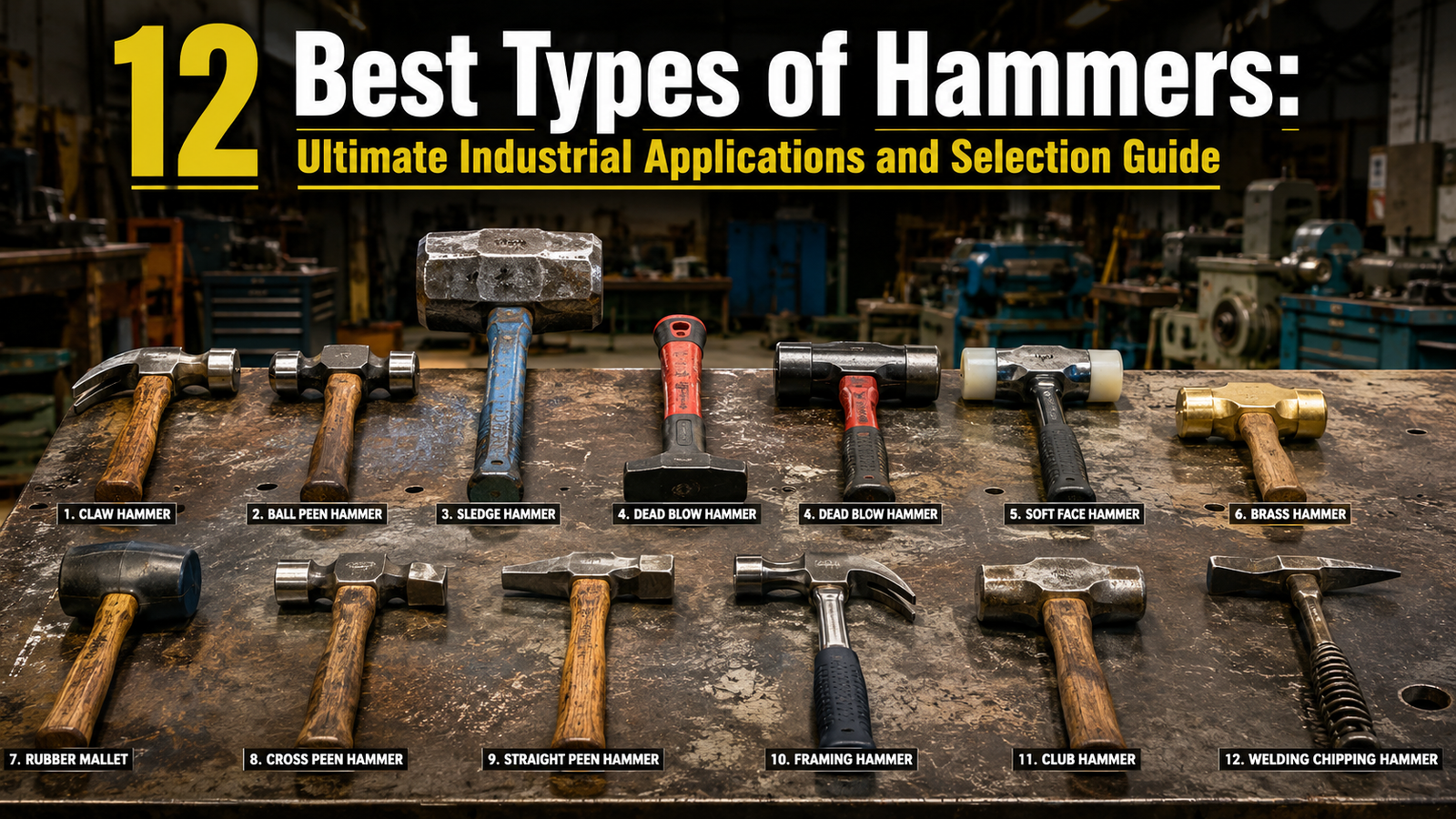
Choosing the wrong hammer in an industrial setting is not a minor inconvenience. It damages workpieces, causes premature tool failure, and creates real safety hazards. Understanding the types of industrial hammers and knowing which one belongs in a given situation affects productivity, protects equipment surfaces, and keeps maintenance costs in check.
This guide covers 12 hammers used across manufacturing, construction, metalworking, and plant maintenance — including how each one works, where it fits, and what to watch out for.
📘 Suggested Course: Maintenance Management & Reliability Crash Course
👉 If you want to understand maintenance strategies, reliability principles, and equipment performance improvement techniques with real-world industrial applications, this course is highly recommended.
👉 Learn complete maintenance management and reliability fundamentals here: [https://trk.udemy.com/qWxAWj]
👉 Get full subscription access: https://trk.udemy.com/PzKGrq
Quick Comparison: 12 Industrial Hammer Types:
| Hammer Type | Main Application | Typical Material | Best Industry Use |
|---|---|---|---|
| Claw Hammer | Nailing, fastener removal | Steel head, wood/fiberglass handle | Construction, carpentry |
| Ball Peen Hammer | Metal forming, riveting | Hardened steel | Metalworking, fabrication |
| Sledge Hammer | Demolition, heavy striking | Hardened steel head, long handle | Construction, mining, structural |
| Dead Blow Hammer | Assembly, positioning | Polyurethane shell, steel shot fill | Automotive, manufacturing |
| Soft Face Hammer | Delicate surface work | Replaceable nylon or rubber faces | Assembly, precision maintenance |
| Brass Hammer | Non-sparking, surface-safe striking | Brass head, wood/fiberglass handle | Oil & gas, explosive environments |
| Rubber Mallet | Woodworking, tile, soft assembly | Rubber head, wood handle | Flooring, cabinetry, bodywork |
| Cross Peen Hammer | Sheet metal, starting nails | Hardened steel | Blacksmithing, fabrication |
| Straight Peen Hammer | Riveting, planishing | Hardened steel | Boilermaking, structural steel |
| Framing Hammer | Heavy nailing, rough framing | Steel or titanium head | Construction, framing |
| Club Hammer | Light demolition, chiseling | Hardened steel, short handle | Masonry, renovation |
| Welding Chipping Hammer | Slag removal from welds | Hardened steel pick/chisel end | Welding, structural fabrication |
What Is an Industrial Hammer?
- An industrial hammer is a striking tool built for repeated use in demanding environments. Unlike consumer-grade hammers sold at hardware stores, industrial versions are rated for higher impact loads, built from tougher materials, and designed with specific head geometries for distinct tasks. Head weight, face hardness, handle material, and balance all vary based on the target application.
📘 Suggested Course: Maintenance Engineering – Predictive Maintenance
👉 If you want to understand predictive maintenance techniques, condition monitoring methods, and failure prevention strategies with real-world industrial applications, this course is highly recommended.
👉 Learn complete predictive maintenance fundamentals here: [https://trk.udemy.com/xJ5yJd]
👉 Get full subscription access: https://trk.udemy.com/PzKGrq
12 Best Types of Industrial Hammers and Their Applications:
1. Claw Hammer:
The claw hammer is the most recognized striking tool in construction and general maintenance. Its flat striking face drives fasteners, while the forked claw on the back extracts nails cleanly from wood or structural panels.
- Purpose: Driving and pulling nails, general carpentry, and light framing work.
- Industrial applications: Formwork assembly, wooden crate construction, light structural repair, facility maintenance.
- Material compatibility: Wood, softboard, drywall, light structural lumber.
- Advantages: Dual-function design reduces tool changes; widely available in 16 oz and 20 oz weights; fiberglass-handled versions absorb shock well during prolonged use.
- Limitations: Not suited for metal-on-metal work; the face is too soft for hardened fasteners; claw geometry can damage surrounding material if used carelessly.
- Selection considerations: Opt for 20 oz steel-head models with fiberglass handles for site work. Milled face heads provide better nail grip; smooth faces reduce wood marking.
- Typical industries: Construction, facility maintenance, warehousing, joinery.
2. Ball Peen Hammer:
The ball peen hammer is a core metalworking tool found in every fabrication shop and machine room. One face is flat for general striking; the rounded peen on the opposite end peens rivets, shapes sheet metal, and hardens surfaces.
- Purpose: Peening rivets, forming metal, driving punches and cold chisels, and closing over fastener ends.
- Industrial applications: Riveting structural assemblies, forming gaskets, setting punches for layout work, light forging operations.
- Material compatibility: Steel, iron, copper, aluminum (with care on softer metals).
- Advantages: Hardened head handles metal-on-metal contact without face damage; the peen shape distributes force evenly when spreading rivet heads; available from 4 oz to 48 oz for varied task scales.
- Limitations: Not appropriate for delicate surfaces or soft metals where marring is a concern; heavier versions cause fatigue during extended use.
- Selection considerations: Choose a weight matching the fastener or workpiece size. For punch work, 16–24 oz handles most tasks; rivet work may require heavier heads.
- Typical industries: Metal fabrication, boilermaking, shipbuilding, HVAC manufacturing, general machining.
📘 Suggested Course: Rotating Equipment Masterclass – Pumps & Compressors
👉 If you want to understand pump and compressor fundamentals, operation principles, and rotating equipment concepts with real-world industrial applications, this course is highly recommended.
👉 Learn complete rotating equipment fundamentals here: [https://trk.udemy.com/PzVKzX]
👉 Get full subscription access: https://trk.udemy.com/PzKGrq
3. Sledge Hammer:
The sledge hammer delivers maximum impact for demolition, breaking, and heavy structural assembly work. Its long handle generates substantial swing force, making it the right tool when a standard hammer simply cannot produce enough energy.
- Purpose: Breaking concrete, driving stakes, demolishing masonry, forcing structural components into position.
- Industrial applications: Concrete demolition, railroad spike driving, pipe driving, structural disassembly, breaking frozen or seized components.
- Material compatibility: Concrete, masonry, rock, heavy steel components, timber stakes.
- Advantages: High impact energy from long handle leverage; double-face heads allow use from either side; hickory handles absorb vibration better than fiberglass on sustained swings.
- Limitations: Heavy and fatiguing in confined spaces; not appropriate near precision components; incorrect swing angle causes glancing blows and muscle strain.
- Selection considerations: Match head weight to the job — 8 lb for stake driving, 16–20 lb for concrete demolition. Check handle length against the available swing arc in tight spaces.
- Typical industries: Civil construction, mining, utilities, demolition, oil field operations.
4. Dead Blow Hammer:
The dead blow hammer is filled with steel shot or sand inside its polyurethane shell. This fill absorbs rebound energy on impact, giving the tool its defining characteristic — almost zero bounce-back after contact.
- Purpose: Pressing bearings, seating components, aligning assemblies without damaging mating surfaces or sending parts flying on rebound.
- Industrial applications: Bearing installation and removal, die and mold seating, automotive component assembly, alignment tasks on precision machinery.
- Material compatibility: Steel, aluminum, cast components, machined surfaces.
- Advantages: Reduced rebound prevents tool injury and component displacement; polyurethane face limits surface marking; maximum force transfer into the workpiece on each blow.
- Limitations: The shell wears with heavy use; not suitable for high-temperature environments where the polyurethane softens; heavier than equivalent steel hammers.
- Selection considerations: Head weight and face hardness vary by manufacturer. For bearing work, a medium-weight (1–2 lb) model with a firm face works well. Larger assembly work needs heavier versions.
- Typical industries: Automotive manufacturing, aerospace assembly, heavy equipment maintenance, precision machining.
📘 Suggested Course: Mastering Pump Fundamentals – Design, Selection & Operation
👉 If you want to understand pump design principles, proper pump selection, and operational concepts with real-world industrial applications, this course is highly recommended.
👉 Learn complete pump engineering fundamentals here: [https://trk.udemy.com/enEqnD]
👉 Get full subscription access: https://trk.udemy.com/PzKGrq
5. Soft Face Hammer:
Soft face hammers have replaceable striking faces made from nylon, rubber, or similar materials. They deliver controlled force to surfaces that would be damaged or distorted by hardened steel contact.
- Purpose: Assembling precision components, seating delicate parts, adjusting machined surfaces without leaving marks.
- Industrial applications: Precision assembly lines, gearbox maintenance, instrument panel work, driving dowel pins and bushings where surface integrity matters.
- Material compatibility: Aluminum, brass, copper, polished steel, finished machined surfaces, plastic housings.
- Advantages: Replaceable faces extend tool life economically; multiple face hardness options available for the same handle; no surface damage on contact.
- Limitations: Limited striking force compared to steel hammers; faces wear faster on abrasive surfaces; not effective for heavy assembly tasks.
- Selection considerations: Match face hardness to the workpiece. Hard nylon faces handle most metalwork; softer rubber inserts protect polished or lapped surfaces.
- Typical industries: Precision manufacturing, electronics assembly, aerospace, medical device production.
6. Brass Hammer:
Brass hammers are non-sparking, softer than hardened steel, and resist marring on precision surfaces. They are the standard choice wherever sparks from steel-on-steel contact create fire or explosion risks.
- Purpose: Driving hardened pins, removing tight-fit components, and working in hazardous atmospheres where spark production is unacceptable.
- Industrial applications: Flammable chemical plants, oil refineries, powder handling facilities, and precision disassembly where surface marking is not permitted.
- Material compatibility: Hardened steel pins and shafts, alloy components, stainless steel fittings.
- Advantages: Non-sparking properties provide safety compliance in explosive environments; soft enough to prevent galling or marring on precision fits; heavier than plastic or rubber alternatives for better force transmission.
- Limitations: Brass heads wear over time from repeated steel contact; heavier than aluminum or nylon alternatives; cost is higher than standard hammers.
- Selection considerations: Use brass hammers where ATEX or OSHA spark-control requirements apply. In standard maintenance without hazardous atmosphere concerns, a soft face hammer may be more economical.
- Typical industries: Petrochemical, pharmaceutical, mining, food processing, explosives manufacturing.
📘 Suggested Course: HVAC Maintenance from Zero to Hero (DUAL HVAC Certification)
👉 If you want to understand HVAC systems, maintenance procedures, troubleshooting techniques, and practical concepts with real-world industrial applications, this course is highly recommended.
👉 Learn complete HVAC maintenance fundamentals here: [https://trk.udemy.com/GbVnbr]
👉 Get full subscription access: https://trk.udemy.com/PzKGrq
7. Rubber Mallet:
The rubber mallet delivers impact without leaving marks. Its head is denser than a soft face hammer insert and handles moderate-force tasks across woodworking, tile setting, and light automotive work.
- Purpose: Assembling wooden joints, tapping tile and flooring into position, fitting body panels, adjusting assembled components.
- Industrial applications: Flooring installation, cabinetry assembly, auto body repairs, pipe fitting, equipment panel adjustments.
- Material compatibility: Wood, composite materials, ceramic tile, light sheet metal, plastic panels.
- Advantages: Completely non-marring on most surfaces; the rubber absorbs some impact energy, reducing component stress; lightweight and easy to control.
- Limitations: Cannot generate the impact force needed for heavy assembly; rubber face deteriorates with solvent exposure; ineffective on hardened steel applications.
- Selection considerations: Choose density based on the task. Harder rubber mallets handle tile and flooring; softer heads work for finished wood or painted surfaces.
- Typical industries: Flooring installation, cabinetry, construction finishing, automotive body shops.
8. Cross Peen Hammer:
The cross peen hammer has a flat striking face on one end and a wedge-shaped peen running perpendicular to the handle on the other. It is built for metalworking tasks that require directional force — spreading, planishing, and starting nails in tight corners.
- Purpose: Spreading metal along one axis, starting nails in narrow spaces, planishing sheet metal, and shaping hot metal in blacksmithing work.
- Industrial applications: Blacksmithing, sheet metal fabrication, structural ironwork, boilermaking, starting fasteners in tight geometries.
- Material compatibility: Mild steel, iron, aluminum, copper sheet.
- Advantages: Directional peen allows controlled spreading without affecting the perpendicular axis; good tool for confined fastener-starting positions; works well in both hot and cold metalwork.
- Limitations: Requires skilled technique to use the peen correctly; not interchangeable with general maintenance hammers; specialized enough that it sees limited use outside metal trades.
- Selection considerations: Weight should match the scale of the metalwork — 1.5–2 lb for sheet metal work, heavier for structural forging operations.
- Typical industries: Blacksmithing, fabrication shops, HVAC ductwork, architectural metalwork.
📘 Suggested Course: Reliability and Maintenance Engineering – FMEA
👉 If you want to understand reliability engineering concepts, failure analysis, and FMEA techniques with real-world industrial applications, this course is highly recommended.
👉 Learn complete reliability and maintenance engineering fundamentals here: [https://trk.udemy.com/VOYZ4a]
👉 Get full subscription access: https://trk.udemy.com/PzKGrq
9. Straight Peen Hammer:
The straight peen hammer has a wedge-shaped peen running parallel to the handle rather than perpendicular. This geometry directs spreading force along the handle axis, making it useful for riveting, planishing, and specific forging operations.
- Purpose: Riveting, spreading metal parallel to the handle direction, planishing flat seams, working metal in tight radii.
- Industrial applications: Boilermaking, pressure vessel fabrication, structural steel riveting, panel beating.
- Material compatibility: Steel, iron, copper, aluminum sheet.
- Advantages: Peen orientation allows force direction that a cross peen or ball peen cannot replicate; good for riveting applications where the straight peen geometry fits the rivet geometry.
- Limitations: Highly specialized — the majority of maintenance technicians will not need this tool unless working in boilermaking or structural fabrication specifically.
- Selection considerations: Used primarily in specialized trade environments. A 1.5–2 lb head weight covers most riveting applications in sheet and structural work.
- Typical industries: Boilermaking, shipbuilding, structural steel fabrication, pressure vessel manufacturing.
10. Framing Hammer:
The framing hammer is a heavy-duty variant of the claw hammer, built for the sustained nailing demands of structural construction. Its head is heavier, the handle is longer, and the milled face grips framing nails better during high-volume driving.
- Purpose: Driving large nails through dimensional lumber for wall framing, floor systems, roof structures, and formwork.
- Industrial applications: Residential and commercial construction framing, concrete formwork assembly, structural wood framing in industrial facilities.
- Material compatibility: Dimensional lumber, LVL beams, engineered wood products, structural panels.
- Advantages: Heavier head (20–32 oz) drives nails in fewer strikes, reducing fatigue over a full shift; milled face reduces nail slippage; magnetic nail starter simplifies single-handed nailing.
- Limitations: Excessive weight for finish work or light carpentry; the milled face leaves marks on finished surfaces; titanium handle versions are expensive but significantly reduce vibration transfer.
- Selection considerations: For high-volume framing, a 22–28 oz head weight balances driving power against end-of-shift fatigue. Titanium handles are worth the cost for full-time framing crews.
- Typical industries: Residential construction, commercial building, industrial facility construction.
📘 Suggested Course: Heat Exchangers – Design, Operation & Maintenance
👉 If you want to understand heat exchanger design principles, operational concepts, and maintenance techniques with real-world industrial applications, this course is highly recommended.
👉 Learn complete heat exchanger fundamentals here: [https://trk.udemy.com/X4nd14]
👉 Get full subscription access: https://trk.udemy.com/PzKGrq
11. Club Hammer:
The club hammer — also called a lump hammer — is a short-handled, double-faced steel hammer weighing 2–4 lb. It is designed for one-handed controlled strikes in masonry work, chiseling, and light demolition where a sledge hammer would be excessive.
- Purpose: Driving cold chisels and star drills, light masonry demolition, breaking mortar joints, and general one-handed striking.
- Industrial applications: Masonry repair, tile removal, anchor bolt installation, HVAC rough-in penetrations, plumbing chases in concrete.
- Material compatibility: Concrete, masonry block, brick, tile, stone.
- Advantages: Short handle provides good control in confined spaces; double face allows use from either side; heavy enough for masonry work without requiring a two-handed sledge.
- Limitations: Not suited for precision work; the double face design offers no peen geometry for metalwork; heavier than a standard hammer for the same one-hand use.
- Selection considerations: A 3 lb club hammer handles most masonry chiseling tasks. Heavier versions are available but reduce one-handed control.
- Typical industries: Construction, masonry, renovation, plumbing, electrical rough-in.
12. Welding Chipping Hammer:
The welding chipping hammer is a purpose-built tool for removing slag from welds. One end is a pointed pick; the other is a flat chisel. Both ends are hardened to handle the brittle slag material that forms on MIG, stick, and flux-core welds.
- Purpose: Breaking and removing slag deposits from weld beads before inspection, painting, or next-pass welding.
- Industrial applications: Structural steel fabrication, pipeline welding, pressure vessel manufacturing, shipbuilding, heavy equipment manufacturing.
- Material compatibility: Slag from carbon steel, stainless steel, and cast iron welds.
- Advantages: The dual-end design handles both flat seam slag (chisel) and corner or root pass slag (pick); lightweight enough for sustained use at height or in confined spaces; spring or coil handle absorbs vibration.
- Limitations: No application outside weld cleaning; the hardened ends chip if used on hardened steel; coil handles heat up near weld zones if not handled carefully.
- Selection considerations: Choose a coil-grip handle version for overhead work — the spring absorbs shock when striking upward. Forged heads outlast cast versions on heavy plate work.
- Typical industries: Welding fabrication, structural steel, shipbuilding, oil and gas pipeline, pressure vessel manufacturing.
📘 Suggested Course: Introduction to Reliability Engineering
👉 If you want to understand reliability engineering principles, failure analysis, maintenance strategies, and equipment performance concepts with real-world industrial applications, this course is highly recommended.
👉 Learn complete reliability engineering fundamentals here: [https://trk.udemy.com/0GjmYP]
👉 Get full subscription access: https://trk.udemy.com/PzKGrq
Hammer Selection Guide by Application:
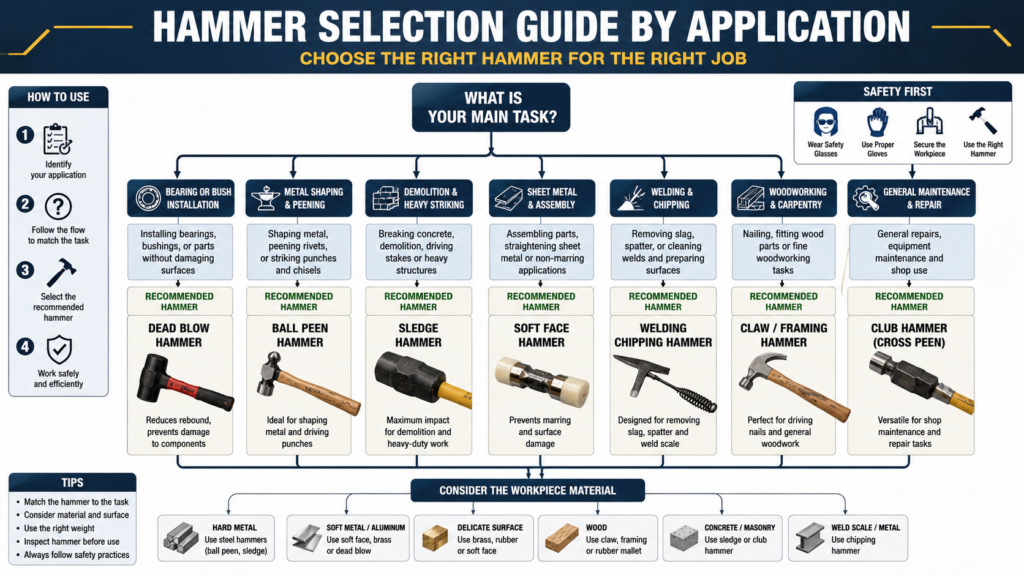
| Application | Recommended Hammer | Why |
|---|---|---|
| Bearing installation on shafts | Dead Blow Hammer | Zero rebound keeps bearing seated; no surface damage |
| Sheet metal forming | Ball Peen or Cross Peen Hammer | Controlled directional force; hardened face handles metal contact |
| Concrete demolition | Sledge Hammer or Club Hammer | Mass and momentum break dense material efficiently |
| Structural framing assembly | Framing Hammer | Heavy head drives framing nails in fewer strikes |
| Weld slag removal | Welding Chipping Hammer | Hardened pick and chisel ends designed specifically for slag |
| Woodworking and joinery | Rubber Mallet or Claw Hammer | Non-marring contact; appropriate force levels for wood assembly |
| Precision equipment maintenance | Soft Face Hammer or Brass Hammer | Protects machined surfaces; non-sparking option for hazardous areas |
| Masonry chiseling | Club Hammer | Short handle provides one-hand control; weight drives chisels effectively |
| Rivet spreading and planishing | Straight Peen or Ball Peen Hammer | Peen geometry directs force for controlled spreading |
| Flammable/explosive environments | Brass Hammer | Non-sparking head meets ATEX and OSHA spark-control requirements |
Common Hammer Selection Mistakes:
- Using a hardened steel hammer on delicate surfaces: A ball peen or framing hammer on aluminum castings or polished surfaces leaves indentations and causes stress concentrations. Use soft face or brass hammers for surface-sensitive work.
- Ignoring hammer weight: Too light, and the tool requires excessive strikes to seat a component — increasing fatigue and the risk of off-center hits. Too heavy, and control drops. Match weight to task scale.
- Using a damaged striking face: A chipped, mushroomed, or cracked face concentrates force unpredictably and sends chips. Remove damaged hammers from service immediately. This is a documented cause of eye injuries in maintenance environments.
- Wrong handle material for the environment: Wooden handles absorb vibration well but crack from repeated oil and solvent exposure. Fiberglass handles are better in wet or chemical environments. In hot work areas, check handle temperature before gripping.
- Choosing a steel hammer for spark-sensitive areas: In oil refineries, chemical plants, or powder-handling facilities, a standard steel hammer is a fire hazard. Only non-sparking tools — brass, bronze, or beryllium copper — are acceptable in those zones.
- Using a claw hammer for metal-on-metal work: The claw hammer’s face is not hardened for metal work. Repeated steel-on-steel contact deforms the face and creates chips — switch to a ball peen or dead blow hammer.
📘 Suggested Course: Centrifugal Pumps – Principles, Operation and Design
👉 If you want to understand centrifugal pump working principles, operation, design concepts, and performance characteristics with real-world industrial applications, this course is highly recommended.
👉 Learn complete centrifugal pump fundamentals here: [https://trk.udemy.com/6kdAGV]
👉 Get full subscription access: https://trk.udemy.com/PzKGrq
Hammer Maintenance and Inspection Checklist:
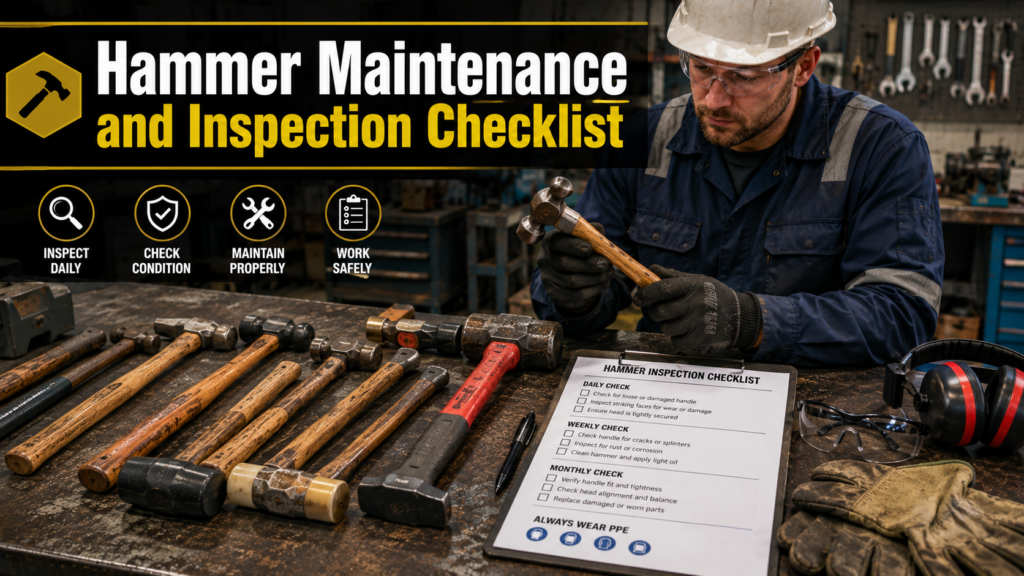
Daily:
- Inspect the striking face for chips, cracks, or mushrooming — remove from service if any are found
- Check handle for cracks, splinters, or looseness at the head connection
- Verify wedges or pins securing the head are fully seated and tight
- Wipe down handle grip surface — oily handles increase slip and drop risk
Weekly:
- Check wooden handles for moisture absorption swelling or drying cracks
- Inspect fiberglass handles for delamination near the head socket
- Confirm dead blow hammer shells are free of cracks and the internal fill is not audibly shifted
- Replace worn soft-face hammer inserts before they lose protective function
Monthly:
- Full inventory audit — account for all hammers assigned to the department
- Check brass hammer heads for wear depth — replace when the face has worn noticeably from steel contact
- Inspect welding chipping hammers for handle heat damage and tip wear
- Record any hammers taken out of service and reorder replacements
- Review PPE associated with hammer use — check face shields and safety glasses for scratches and damage
Frequently Asked Questions:
1). Which hammer is best for industrial maintenance?
- The dead blow hammer and soft face hammer cover the majority of industrial maintenance tasks — bearing work, assembly, component positioning — without damaging surfaces or sending parts flying on rebound. A ball peen covers metal-on-metal striking and punch work. Most maintenance toolkits need all three.
2). What hammer is used for metal work?
- The ball peen hammer is the standard metalworking hammer. It handles riveting, punch and chisel driving, and sheet metal work. Cross peen and straight peen hammers cover specialized forming and planishing work in fabrication and blacksmithing.
3). What is a dead blow hammer used for?
- Dead blow hammers are used when rebound would displace a component or injure the operator. Common applications include bearing installation on motor shafts, seating precision-fit parts, and assembly tasks where each blow must transfer maximum force without bounce-back.
4). Which hammer prevents surface damage during maintenance?
- Brass hammers and soft face hammers are the standard choices. Brass handles non-sparking requirements in hazardous atmospheres. Soft face hammers with nylon or rubber inserts are better for polished or delicate machined surfaces in normal environments.
5). What is the difference between a rubber mallet and a dead blow hammer?
- A rubber mallet is softer and used for non-marring work on wood, tile, and light panels. A dead blow hammer has a harder polyurethane face and internal shot fill — it transfers more force, eliminates rebound, and handles heavier assembly tasks. The two are not interchangeable.
6). When should a brass hammer be used instead of a steel hammer?
- Use a brass hammer anywhere the risk of spark ignition is present — oil refineries, chemical plants, grain facilities, and powder-handling operations. Also use it when a steel hammer would damage a precision surface during pin or component removal.
7). How do I know if a hammer needs to be replaced?
- Remove a hammer from service if the face shows chips, mushrooming, or cracks; if the handle is loose, cracked, or has lost grip material; or if soft-face inserts are compressed below their functional thickness. Do not attempt to re-use damaged hammers — face chips under load become projectiles.
8). What hammer does a welder use to remove slag?
- Welders use a welding chipping hammer — a purpose-built tool with a hardened pick end and a flat chisel end. Standard hammers are not hardened for slag removal and will wear rapidly on contact with the brittle, abrasive slag material.
9). How heavy should an industrial hammer be?
- Match the head weight to the task. Light precision work uses 8–16 oz. General maintenance and metalwork uses 16–24 oz. Heavy assembly and structural work needs 2–4 lb. Demolition and stake driving requires 8–20 lb sledge hammers. Heavier is not always better — control drops with weight.
Final Thoughts:
Selecting the right hammer from the full range of types of industrial hammers is a practical skill that reduces equipment damage, protects workers, and extends tool life across maintenance departments and job sites. A dead blow hammer belongs near every bearing press. A brass hammer belongs in every hazardous-area kit. A ball peen stays in every metalworking station.
The core rule is straightforward: match the hammer to the surface, the force required, and the environment. Keep striking faces clean and intact, replace worn inserts before they fail, and train all new technicians on which tool belongs to which task. Getting this right the first time costs nothing. Getting it wrong costs surfaces, components, and sometimes the operator.